




The trend is similar in the UK, with the UK government’s 10-year infrastructure strategy setting out a pipeline backed by at least £725 billion of public sector funding[2]. The importance of this new infrastructure cycle is not simply the infrastructure itself. From unlocking regional growth and addressing the UK's productivity gap, to creating pathways into employment[3] and lowering the cost of energy[4], infrastructure has the potential to shape economic and social outcomes right across the UK.
While the ambition is clear, realisation of those outcomes is an altogether different matter. The delivery of large-scale infrastructure is often beset with difficulty, and examples of projects that blow their budgets or timescales – or both – are plentiful. Devolution creates an additional delivery complication, requiring the creation of entirely new capability to develop, procure, deliver and transition new infrastructure on an unprecedented scale in the UK.
Poor delivery performance, or at least its perception, is not universal. The programme that underpinned the London 2012 Games delivered a complex portfolio of venues, transport and regeneration projects on time and within budget, albeit a budget that had been revised. While the Elizabeth Line experienced delays and cost increases during its construction and commissioning, it is widely heralded as a success. The UK helped turn offshore wind from an emerging technology into a mainstream source of power, developing globally recognised expertise in delivery along the way. Thames Tideway delivered major environmental benefits for the River Thames and London.
The UK can deliver world-class infrastructure. But in the context of a major pipeline of new projects over the next decade, and with a material proportion of that to be delivered regionally through new or upgraded delivery organisations, the question is whether it can do it repeatably and with the confidence of the public. How can the UK normalise success, and do that in more places at greater face, and avoid the standout failures that undermine public and investor confidence.
Unlocking the funding for infrastructure – who will ultimately pay, and the financing mechanisms to deploy private capital – will also need to be considered and has already been subject to analysis[5]. This paper identifies four tests the UK must respond to if it is to make exceptional delivery, routine. The response to each will either accelerate or block the UK’s ability to realise the opportunity of the new global investment cycle into infrastructure through to 2050.
Meeting these tests requires a permanent delivery capability, available nationally rather than rebuilt programme by programme. This paper proposes a National Delivery Partner: demand-led specialist support through which major programmes and Strategic Authorities can access the best infrastructure delivery resources (people and tools/systems). It would be accountable to the places it supports, strengthening their ability to deliver their own priorities.
If government and industry can build that capability and respond to these tests, the UK will place itself at the forefront of a historic period of global infrastructure investment and the economic growth it supports. If they cannot, the outcome will not simply be fewer projects; it will be slower growth, weaker productivity and missed opportunities for people and places across the country.
Four tests that will decide UK delivery
Consistent delivery depends on strengthening the UK’s infrastructure system as a whole. Neither a single reform nor a succession of project-by-project fixes will be enough.
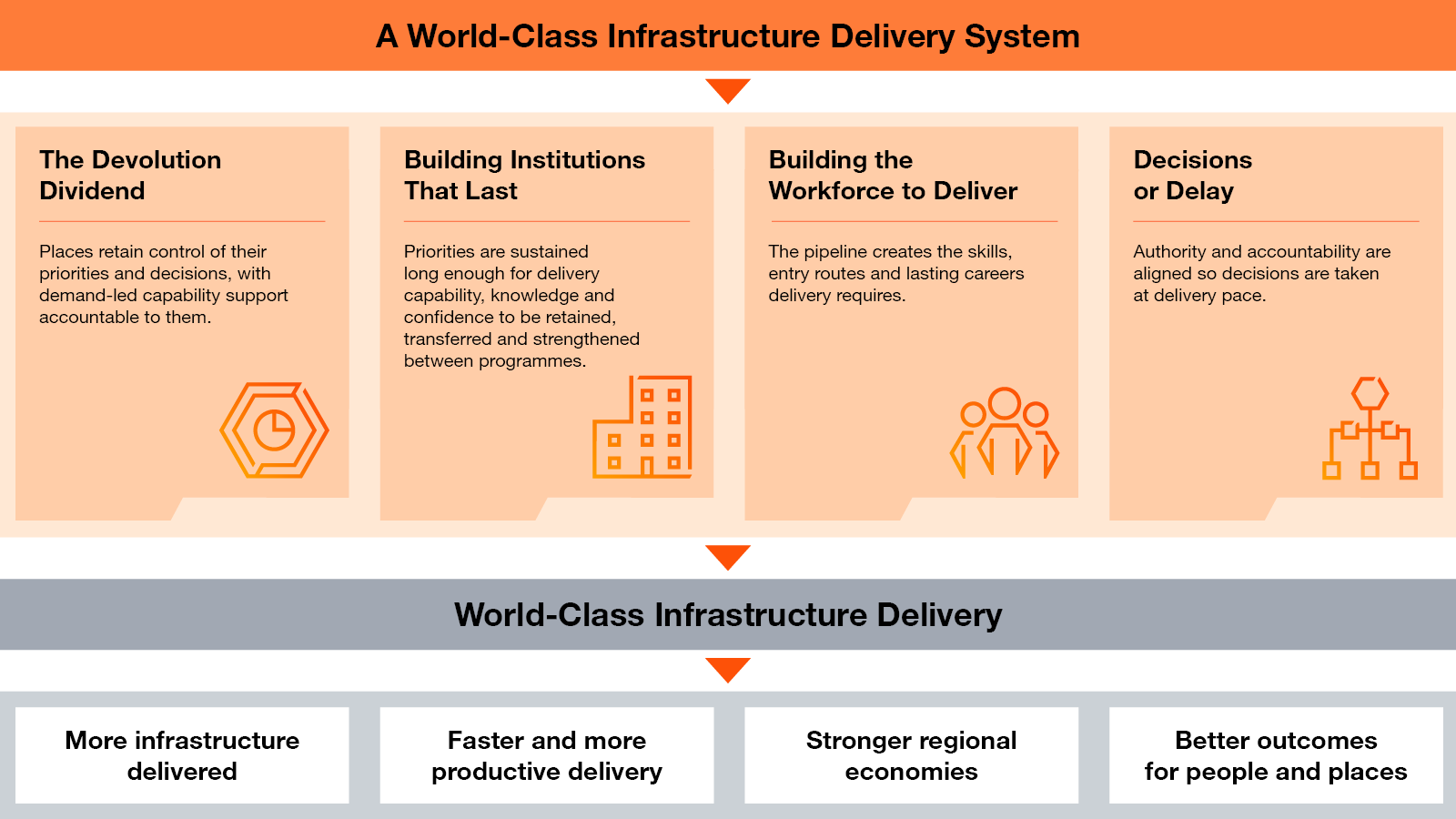
The four tests below set out what that system needs to achieve and why a shared delivery capability matters. Addressed successfully and collectively, they could accelerate delivery; left unresolved, they will reinforce fragmentation, delay and failure.
1. The devolution dividend
Devolution intends to bring infrastructure decisions closer to the people and places that infrastructure serves. Its success will depend on whether strategic authorities can build the capability to develop and be the clients of increasingly large and complex programmes. Without that capability, devolution risks shifting responsibility faster than the capacity to deliver it.
2. Building institutions that last
Projects come and go, but delivery capability must endure. The UK needs sustained priorities and institutions that retain knowledge, develop experienced leaders and transfer capability between programmes. Without continuity, teams, systems and supply chains are repeatedly rebuilt from scratch, preventing experience, productivity and confidence from compounding.
3. Building the workforce to deliver
The UK will not deliver its infrastructure ambitions with the workforce of today. The national pipeline must be used to create clear routes into infrastructure careers, develop critical capabilities, create compelling progression opportunities and facilitate the transfer of capabilities between programmes. This is also a key opportunity for leverage the infrastructure pipeline form part of the solution to the UK’s NEETs issue.
4. Decisions or delay
Infrastructure delivery depends on thousands of timely decisions. Scrutiny and assurance are essential, but too many layers of review can blur accountability and reward institutional caution. The test is whether the UK can create a system in which authority is clear, risks are owned and decisions are taken once, at the right level and at the pace delivery requires.

Test 1: The devolution dividend
The key to delivery, or a new bottleneck?
Context
The UK remains one of the most centralised developed economies, but devolution is accelerating, particularly across England. Strategic Authorities now have greater responsibility for growth, investment, transport and wider policy delivery, with major schemes such as West Yorkshire Mass Transit and Mersey Tidal central to local ambitions for productivity and prosperity.
That shift makes delivery capability decisive. Strategic Authorities must increasingly shape pipelines, develop business cases, secure consent, structure commercial models and act as clients for some of the country’s largest and most complex programmes. A key challenge is whether capacity and capability can grow as quickly as devolved responsibility.
Risk & Opportunity
The maturity and capability of Strategic Authorities differs extensively. Greater Manchester has a long-established capability, having developed Metrolink over more than thirty years, growing it to be the UK’s largest light rail network. Other Strategic Authorities are at a much earlier stage of maturity, some having only recently been formed. At a time when the scale and complexity of delivery expectations are rising there is a risk that, without deliberate support, newer organisations may struggle to deliver on their ambition.
The opportunity is to turn devolution into a stronger place-based delivery model. Strategic Authorities can become capable infrastructure clients, drawing on proven methods, specialist expertise and lessons from mature authorities rather than rebuilding them locally. A National Delivery Partner would make that support available on demand, with each authority defining its needs and retaining control of its priorities and decisions. Greater responsibility, matched by practical capability support, will allow places to translate local priorities into coherent programmes and growth.
Takeaway
Devolution will be judged by what it delivers. Strategic Authorities should establish permanent infrastructure client teams, supported by nationally available specialist expertise and deliberate transfer of both knowledge and capability. That support should be demand-led and accountable to the places using it. Priorities and decisions should remain local; the capability to deliver them should be available everywhere.

Test 2: Building institutions that last
Can the UK sustain its priorities long enough to build institutions and delivery capability that last?
Context
Major public infrastructure is typically delivered through specialist organisations or delivery vehicles. Their effectiveness depends on continuity, repetition and scale: teams improve by applying lessons across programmes, supply chains invest when demand is credible, and people build deeper expertise across a sustained pipeline.
When teams, systems and knowledge are not transferred deliberately, new programmes repeatedly rebuild capabilities and institutional knowhow is lost.
Risk & Opportunity
A model that treats each project as unique and standalone results in the dispersal of delivery teams (and their knowledge) and the dismantling (and rebuilding) of systems. Organisations spend much of their operational lives in the forming stages; few exist long enough to hit peak performance.
The opportunity is to take a longer-term outlook. A limited set of clear, long-term priorities, credible sequencing and stronger mechanisms to retain and redeploy people, systems and proven practice would enable the development of a new generation of delivery organisations: stable, technology enabled and able to continuously improve over the long-term. Infrastructure programmes may start and end; delivery capability should not.
Takeaway
The UK does not lack delivery capability; it lacks a reliable way to retain and transfer it. Every major programme should leave the national delivery system stronger than it found it.

Test 3: Building the workforce to deliver
Can the UK use its infrastructure pipeline to build the skills needed for delivery?
Context
The UK cannot deliver its infrastructure ambitions with the workforce it has today. Investment across energy, transport, water, digital infrastructure and defence will create sustained demand for engineering, construction, technical, commercial and programme-delivery skills, while technology, modern methods and net zero are changing the capabilities required.
At the same time, the UK faces what the recent Independent Report led by Alan Milburn - Young people and work6 calls a ‘moral crisis’ with ‘economic consequences. The review found that a large pool of potential talent remains outside the workforce, with nearly one million 16 to 24 year-olds not in education, employment or training. Six in ten of these one million people have never had a job.
Risk & Opportunity
If workforce planning remains fragmented and starts only as delivery approaches, programmes will compete for the same experienced workers. Costs will rise, mobilisation will stall and employers and training providers will lack the certainty to expand entry routes. The UK could have too few people to deliver its ambitions while leaving available talent disconnected from future demand.
The opportunity is to treat the national infrastructure pipeline as a workforce-development platform rather than a collection of individual labour requirements. Lord Blunkett’s skills review called for a coherent system spanning national, regional and local delivery, with stronger careers guidance, more flexible apprenticeships, closer employer alignment and greater devolution of skills decisions.
For infrastructure, this creates an opportunity to address workforce shortages and youth unemployment together. As Alan Milburn argues:
“Construction is short of hands; too many young people are short of chances. Align the two. Treat the UK infrastructure pipeline as a youth jobs engine: set outcome-based social value targets, back employer consortia to deliver shared training, and guarantee paid, quality placements that convert to sustained roles.”
Takeaway
The UK will not solve its infrastructure skills shortage project by project. It should use the scale and longevity of the national pipeline to create shared routes into work, portable skills and careers that last beyond any individual programme.

Test 4: Decisions or delay
Does the system enable accountable decisions at the pace delivery requires?
Context
Infrastructure projects operate within complex governance and regulatory environments. Scrutiny, assurance and clear accountability are essential, particularly as schemes become larger and more consequential, but they must also enable decisions at the pace delivery requires.
Every major programme depends on thousands of decisions across government, regulators and delivery organisations. The problem arises when layers of review blur ownership, leaving delivery bodies accountable for outcomes without the practical authority to act.
Risk & Opportunity
Layered governance can fragment rather than strengthen accountability. When several organisations can influence a decision without clearly owning it, difficult choices are escalated, revisited or deferred. Where leaders are visible but constrained, seeking another review becomes rational but can slow delivery, increase cost and weaken confidence.
The opportunity is to align authority with accountability. Decision rights should be clear from the outset - who recommends, assures, decides and owns the resulting risk - with proportionate governance, agreed tolerances and escalation reserved for choices that genuinely exceed them. Delivery leaders can then act with autonomy while oversight remains focused on the outcomes and risks that matter most.
Takeaway
Accountability without authority creates delay. The UK needs delivery organisations that are properly scrutinised, clearly accountable and empowered to act.
Conclusion: A national delivery partner, regionally focussed
Accelerating the development and delivery of the UK's Infrastructure Pipeline
Recommendation:
The four tests point to a common requirement: delivery capability that is available where it is needed and endures beyond individual programmes. The UK should establish a National Delivery Partner to provide that continuity through demand-led capability support, not a new tier of control. Strategic Authorities would choose the support they need, set its scope and hold the Partner accountable for its contribution. Places and major programmes would retain responsibility for their priorities, solutions and delivery decisions. The Partner would strengthen their ability to deliver, without reclaiming devolved powers or creating another layer of approval.
Its role would be to provide experienced people, proven methods and scarce capabilities that cannot realistically be maintained within every delivery body. Support could span business-case development, delivery-model design, commercial strategy, governance, mobilisation and project controls, with scope and outcomes agreed with the commissioning authority or programme. The aim would be to give Strategic Authorities ready access to the best experience without repeated, lengthy and expensive procurements, through compliant arrangements that make specialist support easier to draw on.
The Partner would also act as an institutional memory for UK infrastructure delivery. It would retain and transfer knowledge, tools and good practice between programmes and places. These would be resources for local teams to adapt, not standard solutions imposed from the centre. By helping delivery organisations build their own capability, it would strengthen local ownership and allow each to benefit from national experience.
Contact us

Partner, UK Leader for Central Government, Capital Projects & Infrastructure, PwC United Kingdom
Tel: +44 (0)7841 803132