



A progress update of this case study is now available, but we recommend reading this original version (from 2022) first for important background and context.
Read the progress update Read the full report
Most organisations understand that the value of drone solutions is in the data. However, this understanding is not always reflected in drone implementations and, as a result, not all the anticipated benefits materialise.
Organisations who choose to implement drones do so with the expectation that they will be faster, cheaper and safer than existing approaches. The physical nature of the technology can often lead to a perception that drone implementation is complete when drones are purchased and pilots trained or a drone service provider is chosen. This is only part of the story and common drone implementation pitfalls include:
- More focus on “flying or buying drones” than on how to generate fit-for-purpose data that is integrated with existing systems
- Drone data not shared effectively with all stakeholders
- “Siloed” drone use in different areas of the company or project, resulting in data of varying standards and often in the duplication of data capture
- A lack of centralised governance and control over the organisation’s drone use
- An immature procurement process for drone services risking higher costs and data that is not fit-for-purpose
These issues emerge when a company does not consider the entirety of the drone workflow (see below), before starting the implementation.
PwC’s 4 Step Drone Workflow
Effective drone solutions “start at the end” by ensuring that a comprehensive understanding of Sharing requirements informs the design of Permission, Capture and Processing stages. Our 4 step model enables us to maximise the value of drone solutions by designing them to integrate with our clients’ “business as usual”.
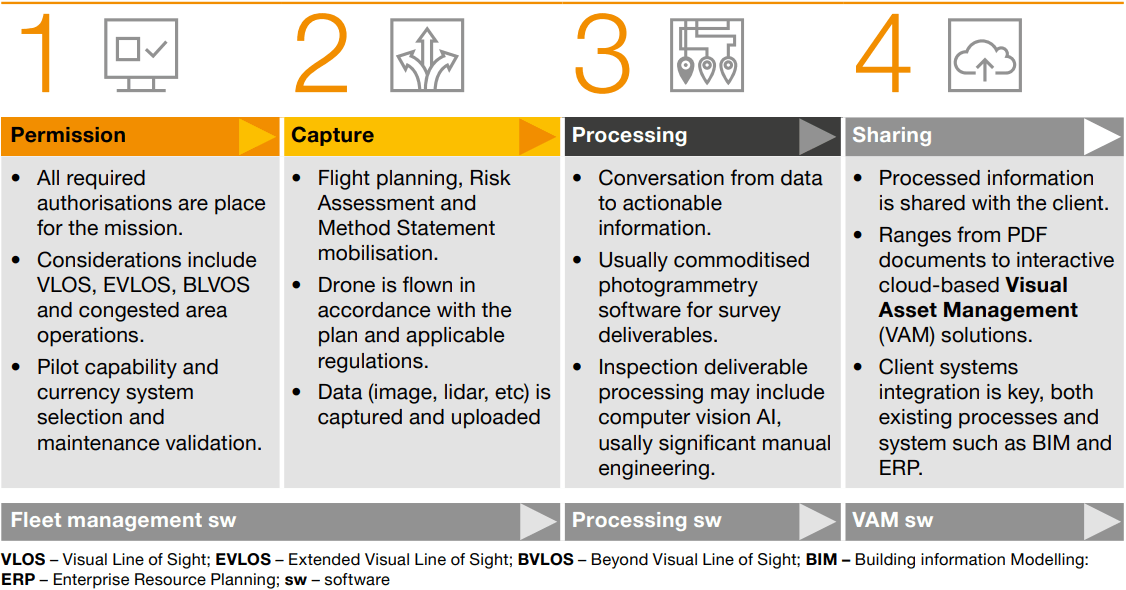
One way to ensure that all aspects of the workflow are considered is to “start at the end”, making sure that there is a clear understanding of exactly how drone captured data will ultimately be used, who will use it and which existing systems it must integrate with. It is also key that all relevant stakeholders are involved in this discussion, and that equal weight is placed on all four steps of the drone workflow. This approach ensures that the drone implementation is driven by a clear need and meets the precise end user requirements. The most effective implementations also include Fleet Management software and Visual Asset Management (VAM) software.
One company with a history of transforming how its clients “Share” data (step 4) is UK-based Cyberhawk. Cyberhawk has built a VAM software solution called “iHawk” that enables their client’s stakeholders to intuitively view drone-captured and other relevant data in the cloud, using a simple map-based interface, with just a browser required to access. The VAM data is often integrated with their client’s existing systems.
“Cyberhawk helps SSEN Transmission monitor over 11,500 transmission towers and almost 150 substations, providing actionable insights via its cloud-based, GIS and IoT-enabled visualisation platform, iHawk. The adoption of iHawk has offered SSEN Transmission’s operational, project and asset teams unprecedented levels of access to multi-level data, allowing them to gain a more comprehensive understanding of the network, exposing integrity and compliance risks, and revealing opportunities for improvement. In SSE words, “iHawk’s innovative approach to data management is key to managing our network assets, central to how our operations team manage inspections, maintenance, safety, and compliance.”
Cyberhawk
Drone efficiencies are enabled through organisation-wide standardisation of permission, capture, processing and sharing steps including deployment of software that integrates with business as usual. This can increase efficiency, lower costs, enhance collaboration, reduce risks and minimise carbon emissions.
There are already software packages on the market that cover all four steps in the workflow and we expect that this integrated approach will continue to gain traction. We also expect more organisations to focus on demonstrating their compliance with the CAA requirements by adopting organisation-wide fleet management software. Fleet management software enables organisations to oversee all their drone activities from a central dashboard including scheduled and historical flights, pilot currency, equipment condition and in some cases much more. Dronecloud is an example of one UK company providing such software.
“The Dronecloud platform helps bridge the gap between drone flight management tools (fleet management, logging) and UTM systems and services to provide users with the ability to deploy large scale operations safely. Since using the Dronecloud platform, our customers have grown from single-use, low-volume operations to more complex (BVLOS) advanced operations, deployed at scale.
Like many of our customers, Network Rail wanted to scale operations but were held back by manual processes. Dronecloud removed Network Rail’s manual workflow through centralised and automated management operations of Flight Approvals, Flight Planning, Airspace, Compliance and Fleet Management. Since using Dronecloud to manage the entire drone operation for 18 months, Network Rail has seen an increase in flights carried by internal pilots of 500% (over 3000 flights per year). In addition, the average flight approval time – which previously took 14 days – has been shortened to under one hour. This has massively increased operational bandwidth.”
Dronecloud
There will be an increasing demand for VAM packages and fleet management software, as organisations realise the limitations of their existing systems when it comes to getting the most out of drone data and achieving efficiencies in their drone operations.
Ultimately, with all of the required technology in place (see section 2 in the Skies Without Limits V2.0 report), we could find ourselves in Industry 4.0. This could mean that flights are triggered by an AI generated requirement, such as a planned maintenance schedule or an alert, and all four steps of the drone workflow model are carried out automatically, including Autonomous drone flight. In this scenario, human involvement would only be required if anomalies are detected by the AI analysis of processed data. There is even the chance that this AI analysis could happen in “real time” on the edge, i.e. at the drone itself.


This case study is an extract from the report
Skies Without Limits v2.0