



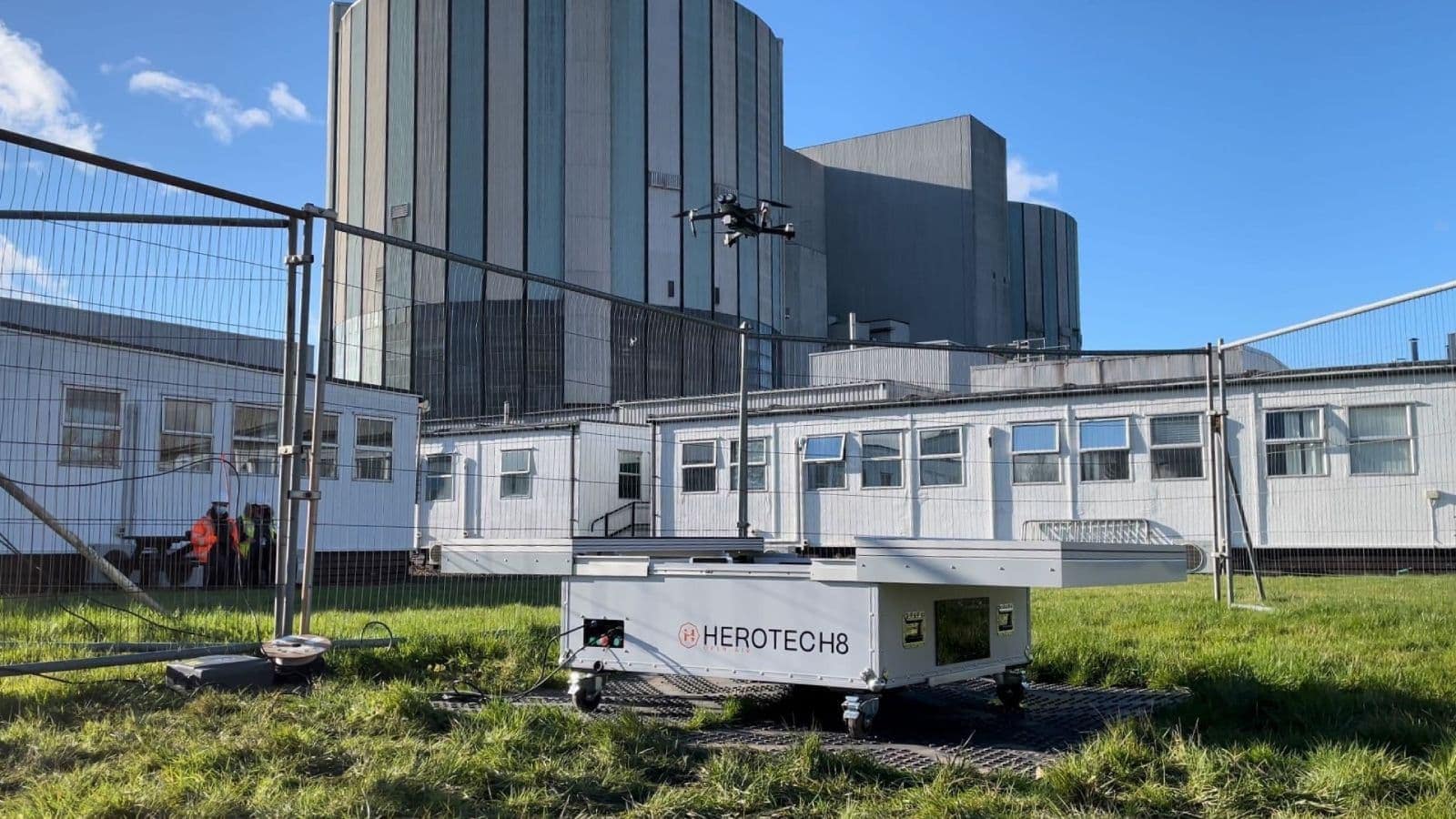
Security cameras are nothing new. In fact, in the UK it is estimated that we have as many as one camera per 14 people in the country. However, the fixed nature of these cameras comes with its downsides. Blind spots and an inability to cover all areas of interest can limit their effectiveness, as can an organisation’s ability to effectively monitor the security data that they gather. Drone solutions can address many of these problems and use cases for security drones are now emerging in the UK.
The most common concept on the market right now is the Drone-in-a-Box, which is exactly how it sounds. The drone is housed in a “box” until it is needed, at which point it autonomously takes off, flies its mission and then lands back in the box. The box is essentially a weatherproof container that protects and charges the drone when not in use.
One example of the Drone-in-a-Box concept comes from HeroTech8 who has designed a solution with security in mind. Drone flights from the box can take place on either a scheduled basis or when triggered by security system IoT sensors. When the drone is flying a routine scheduled flight, it is able to look for anomalies or changes at a site, flagging anything that looks out of place or suspicious for immediate video stream review or subsequent analysis. If the drone is triggered by an onsite IoT sensor, it will take off and fly directly to the cause of the alarm to give the security team “eyes on”. The drone can also use real time AI to detect suspicious behaviour and track intruder movement around a site. Herotech8 has designed its box to work with a wide range of security systems as well as different drone and sensor types, allowing for straight forward integration with existing security protocols.
“At less than the cost of a single full time security personnel, even on a part-time basis, we’ve observed cost-saving potentials of over 45% OPEX just for medium-sized security teams on critical infrastructure applications and, depending on the nature of the infrastructure asset/facility, the cost-saving potential (% of OPEX) further increases when including parallel industrial inspection activities.
Increasingly, inspection flights are also being executed, to capture high-resolution video and imagery of hard-to-reach structures such as rooftops, stacks and masts that would otherwise have required a drone-operating contractor or risky rooftop/rope-access. As such, even in this single unit installation, the extensive value that a Drone-in-a-Box solution can provide is very clear.
To provide a real-life example of our solution, a critical infrastructure customer in Europe operates a pair of our systems to provide a patrol of the perimeter every three hours. The system is operating under full “BVLOS” (beyond visual line of sight) conditions. These systems are “supervised” with a security guard observing the video feed on a computer and controlling the camera.
However, the real opportunity lies in “unsupervised” drone operations, where no supervision by the customer is required. By removing the human involvement, we can fully resolve the scalability challenge of the business case, allowing for one-to-many or fully automated operations.”
Herotech8
It is not currently possible to deploy a Routine BVLOS Drone-in-a-Box solution in the UK but this example from Herotech8 and other global examples from companies such as Azure and Airobotics show the considerable potential for this approach. If a different approach to legislation and regulation is adopted, and assuming that public privacy concerns can be addressed, there is likely to be significant future opportunity in this space.
This case study is an extract from the report
Skies Without Limits v2.0