



A progress update of this case study is now available, but we recommend reading this original version (from 2022) first for important background and context.
Read the progress update Read the full report
Leaks are a big deal in the water industry. In the UK, it is estimated that just under three billion litres of water per day are lost to leaks. OFWAT has responded to this and set performance commitments for water companies, expecting them to reduce overall leakage by 16% by 2025. Technologies such as drones will play a key part in this due to their potential to detect leaks more quickly and safely than traditional approaches.
Drones can be integrated into a water company’s business as usual activities, delivering benefits to multiple operational areas. With a thermal imagery and/or multispectral sensor attached, drones can detect leaks and pinpoint their location, highlighting specific areas for ground crew to investigate and address. They do this by looking for variations in either the temperature or spectral profile of the ground surrounding water pipes and flagging areas that are not as expected. This minimises time spent searching for leaks and may reduce the amount of excavation required for a given issue. Drone use in the water industry is not limited to leak detection, other applications include topographic mapping, asset inspection and “as built” 3D modelling of infrastructure.
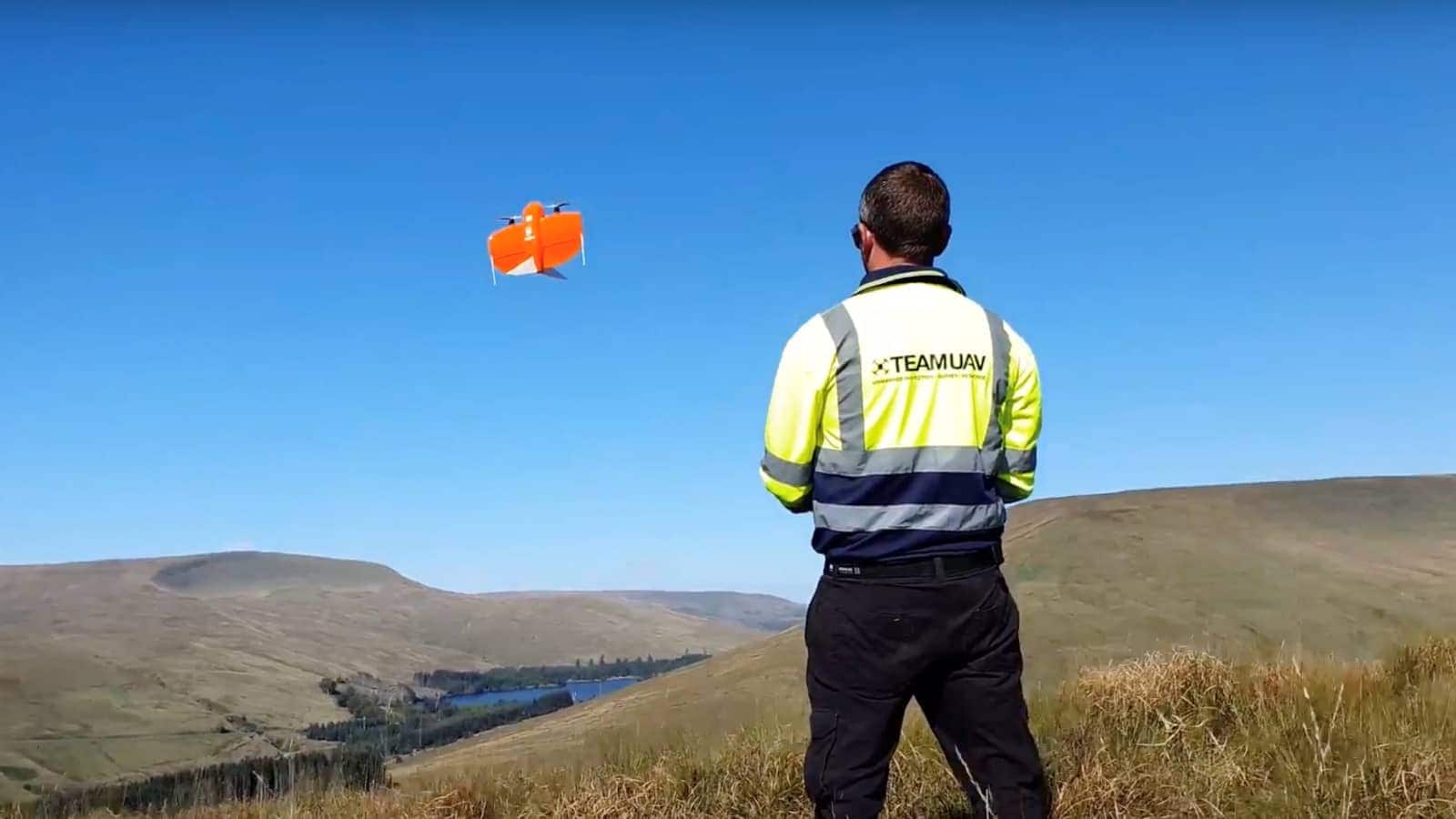
One drone operator providing a range of services to the Water Industry is Team UAV. Team UAV has combined multispectral cameras with a bespoke algorithm to indicate where leaks may be present, sharing this with their utility client to enable them to target further investigation. They have also used drones to create 3D “as built” models of pump station networks for large UK water companies.
“Drones have not only provided a new and innovative approach to leak detection, but they have increased safety of personnel compared to more traditional methods such as walking the route whilst searching for leaks. They have created efficient workflows, contributed to reducing carbon emissions and lowered the cost of routine inspections. As a by-product of collecting leakage data, we’re also able to supply up-to-date asset maps which can be used to plan construction of new pipes or schedule and estimate maintenance of the existing network. Our leak detection method using drones has a 75% accuracy rate and increases efficiency by a factor of ten. As the industry grows and as BVLOS (beyond visual line of sight) regulation develops, this efficiency will grow further..”
Team UAV
Going forwards, drones are likely to see increased use within the water industry and form a critical part of an overall network of robots and IoT sensors. Drone-in-a-Box solutions could immediately dispatch drones to locations flagged by IoT sensor alerts, enabling rapid, multi-sensor analysis of a problem area. Drones could also be scheduled to periodically capture data which feeds into an overall model of the utility’s water network. This could include the use of BVLOS drones to autonomously capture water samples that enable ongoing environmental monitoring. The large amount of pooled data continually collected by this network will begin to pave the way for greater efficiencies and predictive maintenance across the water industry.
This case study is an extract from the report
Skies Without Limits v2.0