


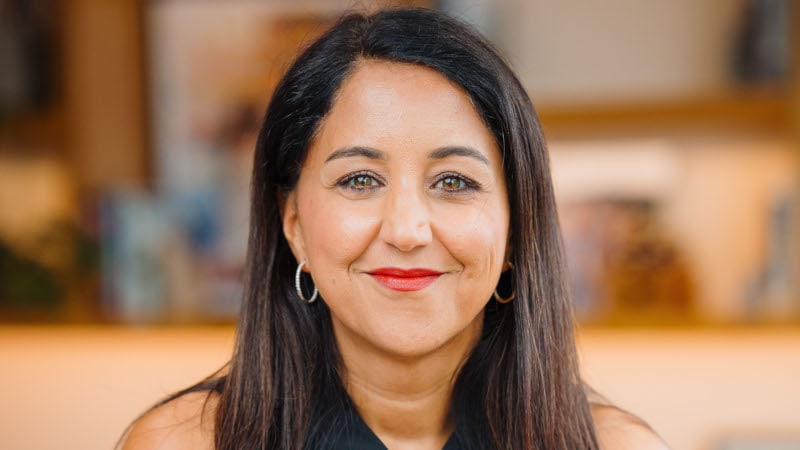
“We are in a labour revolution right now,” Zahra Bahrololoumi, CEO, Salesforce UK & Ireland
On managing a workforce of AI agents, getting the board on-board with innovation and ensuring responsible tech use.
“I believe business leaders today are the last generation that will lead an all-human workforce,” says Zahra Bahrololoumi, CEO, Salesforce UK & Ireland.
Bahrololoumi is talking about the rise of AI agents acting with greater autonomy in the workforce to perform tasks from front-end customer service to back-end data processing and reporting. It’s a trend that will require business leaders themselves to adapt and rethink their operations and business models.
“We are in a labour revolution right now. We are in the era of agentic AI,” says Bahrololoumi.
“Over the next year or two, there will be thousands of AI agents in workforces. Processes will no longer be constrained by human capability. Leaders are going to have both an agent workforce and human capital workforce.”
An example Bahrololoumi gives of agentic AI in action is Salesforce’s use of its Agentforce on the help.salesforce.com customer helpdesk. Since introducing Agentforce in Autumn last year, Bahrololoumi says the company has seen around 84% of helpdesk queries dealt with by agentic AI. “Not deflected,” adds Bahrololoumi, “resolved”. Around 2% are escalated to a human.
Over the course of the year, Salesforce expects the number of queries handled by AI to number over 50 million. This has enabled the organisation to redeploy “a couple of thousand people” from its helpdesk operation to “other high-value areas” across the business - “because we’ll always need good people,” adds Bahrololoumi.
“You think about that value case,” she says. “Businesses can't ignore that.”
However, Bahrololoumi is well aware that AI in general, as with all emerging technologies, has seen some discord between early expectations and the outcomes many organisations have seen. The PwC CEO Survey highlighted a ‘reality check’ for GenAI over the past year.
Bahrololoumi says this owes much to the fact that early expectations were shaped by several factors: serial small scale pilots that didn’t ladder up to a meaningful strategy; wrong-turns in terms of businesses taking a do-it-yourself approach that incurred cost and complexity; and a failure to put in place the right data strategy - “because AI is only as good as the data it has to work with,” she says.
How to lead a workforce of people and AI agents
Bahrololoumi says business leaders remain committed to exploring AI’s value and are highly engaged in discussions about how agentic AI can deliver organisation-wide benefits.
“Boards are more savvy than ever,” she says. “They are taking an active interest. It's not just the executive teams, we are hosting the executive team alongside boards. That hasn't happened before, at least not in my career, where boards are actively involved, guiding, and stepping in.”
She says that engagement is critical. For agentic AI to deliver value at scale across an organisation, business leaders will need to be champions and sponsors of the tech-powered change it can deliver. That will mean understanding its potential - and risks.
Trust, integrity and responsible AI
“Whether you’re working with people or AI agents, you can't get away from operating with trust and integrity,” she says. “It’s essential to think about the guardrails, responsible growth, and ensuring diverse teams structure data appropriately.”
Business leaders must understand what tools they have at their disposal to mitigate issues around security, privacy, hallucinations, toxicity and bias. That may mean balancing speed and efficiency with ensuring heightened levels of accuracy, identifying appropriate tolerance levels and setting guardrails accordingly.
It is also essential they know what they want their agent workforce to do, how they will measure its success, and what mitigations and escalation processes need to be in place.
“You have to define a business outcome that you want the agent to achieve,” says Bahrololoumi. “For instance, in a recruitment-as-a-service example, you might look at the number of CVs assessed, or successful placements made.”
“You can also predetermine and set the parameters within which agents work. For example, if a bank’s agent detects a vulnerable customer, they are instructed to route that case to a human to ensure the situation is handled appropriately.”
Performance management in an agentic age
Agents will be subject to a very different kind of accountability and performance management than human counterparts, but business leaders should still think about what that process looks like, how they test the performance of agents, and what to do if they are underperforming.
“The concept of performance management may shift dramatically, but it will be important to establish an audit trail to confirm that agents are doing what is expected.”
While business leaders must take responsibility for the use and performance of AI, the technology will likely see greater regulation, with the EU AI Act coming into full force this year, and further legislation on the horizon.
However, Bahrololoumi says she has been encouraged by the UK government’s approach so far.
“I admire the current government's pragmatic approach,” she says, “they’re attempting to balance risk and opportunity. However, we are still in very fledgling times.”
One thing seems certain though, the age of the AI-augmented workforce is upon us.
As Bahrololoumi concludes: “The possibilities of transforming workforces are endless and limitless.”
28th UK CEO survey
Read full findings
CEO interviews: Exclusive insights from UK business leaders
Explore what leading UK CEOs have to say about their business plans and priorities.

Zahra Bahrololoumi,
Salesforce

Frances Russell,
Absolute Collagen

Lynn Perry,
Barnardo’s

Natalie Campbell,
Belu Water

Andy Gregory,
BGF

Paul Flaum,
Bourne Leisure

Sean Doyle,
British Airways

Shobi Khan,
Canary Wharf Group

James Bradley,
Churchill Group

Samantha Graham,
Clean Sheet

Mike Norris,
Computacenter

Jill Popelka,
Darktrace

Jo-Jo Hubbard,
Electron
Hatul Shah,
Sigma Pharmaceuticals Group

Katy Wigdahl,
Speechmatics

Nadeem Boghani,
Splendid Hospitality

Alistair Phillips-Davies,
SSE

Nicola Shaw,
Yorkshire Water

Jenny Walton,
Refugee Employment Network
Contact us