





The Economic Crime and Corporate Transparency Act 2023 - getting ready for compliance

Summarising the significant reforms and the key actions businesses can take to prepare for the changes

Important changes are being introduced by the Economic Crime and Corporate Transparency Act 2023 (“ECCTA”). ECCTA is a new piece of legislation that aims to combat economic crime and prevent the abuse of UK corporate entities by enhancing the quality and accuracy of data on the UK register of companies. It will also introduce a new offence in relation to the failure to prevent fraud and expands the scope of the identity doctrine for economic crime offences.

These changes are coming into force on a staggered basis throughout 2024 and beyond, and failure to comply may result in fines of up to £10,000 and other enforcement actions.

It is recommended that companies take action now to prepare for the changes.

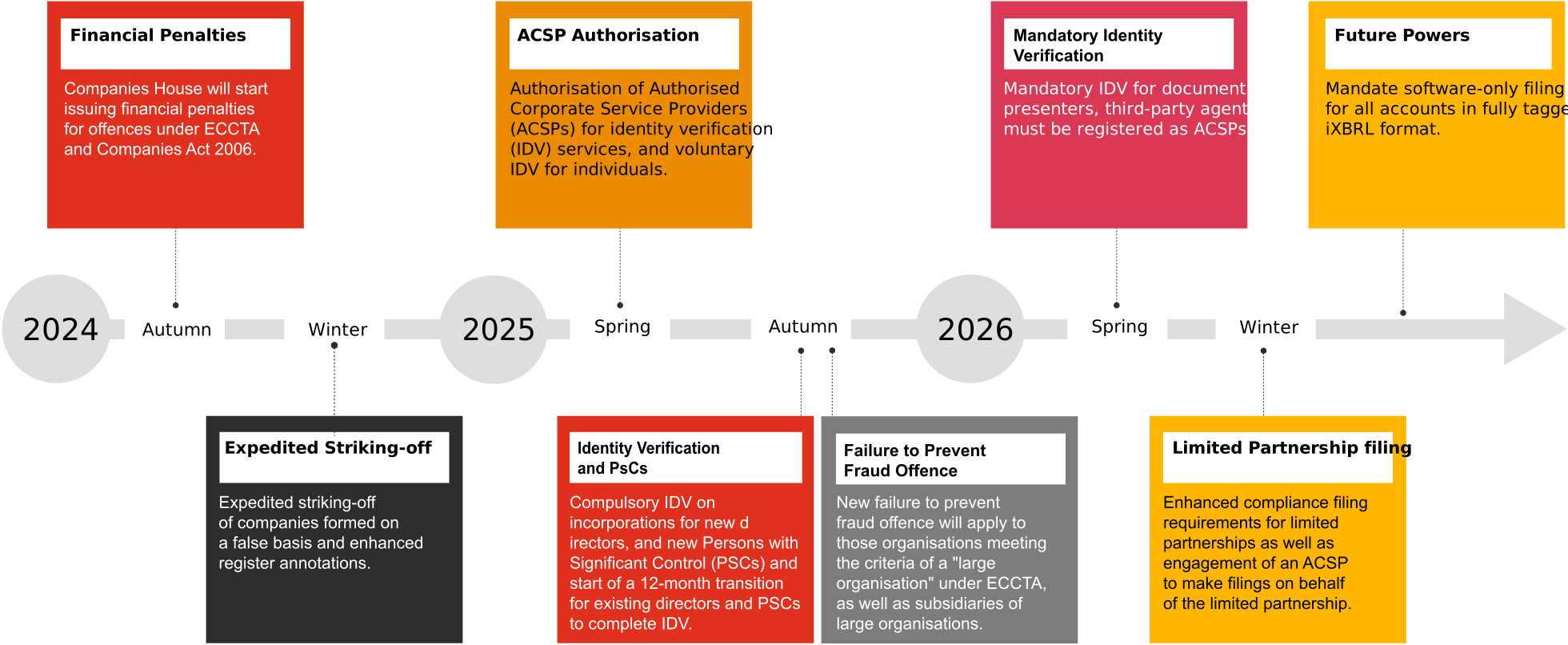
ECCTA Transition Timeline
Key Changes

In force

  • Powers to query information: The registrar now has expanded powers to query and challenge information that seems incorrect or inconsistent, remove inaccurate, incomplete, false, or fraudulent information more swiftly, use annotations on the register to highlight potential issues with supplied information and clean up the register by identifying and removing inaccurate data.
  • Company name checks: Companies House can now reject an application to register a name where they have reason to believe the name is intended to facilitate fraud, the name is comprised of, or contains, a computer code, or where the name is likely to give the false impression the company is connected to a foreign government, or an international organisation, whose members include two or more countries or territories (or their governments). Companies House can also direct companies to change their name in some circumstances.
  • Lawful purpose statements: A new requirement has been introduced for company incorporations, where the subscribers must confirm the company is being formed for a lawful purpose. Additionally, companies must affirm that their intended future activities are lawful in their annual confirmation statement on an annual basis. Find further information on what constitutes a lawful purpose and what steps you can take to support the making of the statement.
  • Registered office address: ECCTA introduces stringent rules for registered office addresses, mandating that companies must maintain an 'appropriate address' at all times. An 'appropriate address' is defined as one where a document can be expected to reach a company representative when delivered by hand or post and where the delivery of documents can be recorded through an acknowledgement of delivery. Companies may no longer use a PO Box address as a registered office address.
  • Registered email address: All companies need to provide a registered email address for Companies House to use to communicate with the company. It will not be available on the public record. Existing companies will need to provide the email address when filing their first confirmation statement from 5 March 2024 onwards.
  • Investigation, enforcement and data sharing: Companies House has new investigation and enforcement powers and new powers to share data with law enforcement agencies and other government departments.

Coming into force in future:

  • Expected spring 2026: Filing documents with the registrar: Once in force, an individual can only deliver documents to the registrar on their own behalf or on behalf of a company if they are ID-verified or an ACSP. The registration process for ACSPs will commence on 18 March 2025.
  • Expected in future: Corporate directors: Corporate directors will only be able to be appointed where they are UK corporate entities with ‘legal personality’ and where the directors of the corporate directors are natural persons.
  • Expected in future: Improving transparency of company ownership: Companies will be required to record the full names of shareholders who are individuals and the full names of corporate members and firms in their registers. Companies will also be required to provide a one-off full shareholder list to Companies House. The conditions will allow a relevant legal entity to be recorded as a person with significant control (PSC) will be collected and displayed, as well as reasons for exemption from providing PSC details where relevant.
  • Expected 2025: Protecting personal information: From January 2025, individuals will be able to suppress their residential address from historical documents where it was the registered office address. From spring/summer 2025, further personal details can be suppressed from historical documents such as residential addresses, day of birth, business occupation and signatures. Evidence will not be required and suppression will be automatic. Protection will also be offered for those at risk of harm by concealing sensitive information like names and addresses.
  • From 18 November 2025: Mandatory IDV
    • All new directors and LLP members will need to verify their identity in advance of incorporating a new company, or to be appointed to an existing company. A 12 month transition period will begin for existing directors and LLP members to have their identity verified in advance of filing their first confirmation statement due from 18 November 2025. 
    • PSCs will be required to verify their identity and submit a statement to Companies House confirming their identity has been verified in accordance with the following timeline:
      • If they are registered as a PSC after 18 November 2025, the PSC will have 14 days to submit their statement from the date they register as a PSC with Companies House;
      • If they are already a PSC on 18 November 2025, their 14-day period starts from the company’s confirmation statement date - if they are also a director of the company;
      • If they are not a director of the company, their 14-day period starts from the first day of their month of birth, as it is shown on the Companies House register. For example, if the date of birth is shown on the register as March 1990, the 14-day period will start on 1 March 2026.
  • Individuals can voluntarily complete their IDV utilising the Gov.UK. One Login or via an ACSP in advance of the transition period.
  • From Spring 2026: IDV will be required for presenters filing any document with Companies House and third-party agents filing on behalf of a company with Companies House will be required to be registered as an ACSP. IDV will also be required for general partners of limited partnerships.
     
  • Expected Winter 2026: Limited Partnerships will need to file more information with Companies House such as submission of an annual confirmation statement, notification of changes to the LP and its partners and the need for registered officers and named contacts of GPs to be notified. In addition, Limited Partnerships will need to use an Authorised Corporate Service Provider (ACSP) to make filings at Companies House on their behalf. It will not be possible for Limited Partnerships to make their own filings.

    Find out more about how we can support the Limited Partnerships in your structure.
  • Expected in future: Software-only accounts filing: Companies House will transition to filing accounts by software only in digital format. Paper filing options will no longer be available. This will mean that accounts must be filed digitally in fully tagged iXBRL format, therefore companies should review their timelines to ensure accounts are tagged in advance of the Companies House filing deadline.

    Companies House are also expected to release a new ‘File My Package Accounts’ service from January 2025 to allow package accounts to be filed digitally, firstly for UK Single Electronic Format accounts and Welsh dual submission, followed by limited partnerships and group package accounts. It is expected that this service will be expanded in April 2025 for audit exempt, filing exempt and Community Interest Company packages, with Overseas Companies to follow in future. Accounts will be required to be iXBRL tagged and in zip file format.
  • Expected in future: Changes to small and micro-entity company accounts filings: Small and micro-entity companies will need to file their profit and loss accounts. Small companies that do not qualify as micro-entities will also need to file a directors’ report. The option to file abridged accounts will be no longer be available.
  • Expected in future: Audit exemption: Companies will need to include an additional statement on the balance sheet to confirm which audit exemption is being claimed and to confirm that the company qualifies for the exemption.

    Read more about how we can help with preparation of and filing of accounts.
  • On 1 September 2025 ECCTA will bring in a new strict liability offence for large organisations and their subsidiaries who fail to prevent certain fraud offences being committed by their associated persons. These fraud offences must have been carried out by an associated person acting for or on behalf of the relevant body (i.e. the large organisation) and have intended to benefit the relevant body or its clients. The specific fraud offences covered by this include: false representation; failing to disclose information; abuse of position; obtaining services dishonestly; participation in a fraudulent business; false statements by directors; false accounting; fraudulent trading; and cheating the public revenue. The new offence applies widely to incorporated organisations meeting the criteria of a ‘large organisation’ under ECCTA. If an employee or other associated person of a subsidiary of a large organisation commits a fraud intended to benefit the subsidiary, the subsidiary may still be prosecuted, even if it doesn't meet the criteria of a large organisation itself. The only defence available is that the relevant body had in place reasonable fraud prevention procedures. The UK Home Office issued guidance around what constitutes reasonable procedures on 6 November 2024.
  • ECCTA has reformed the identification doctrine by broadening the scope of corporate liability for certain economic crimes. It steps away from the 'directing will and mind' definition and replaces it with a more expansive 'senior management' one. Therefore, any and all individuals who play significant roles in decision-making, even if they are not formally directors or officers, can invoke corporate liability for these particular offences. This change aims to hold companies accountable for the actions of a wider range of employees, thereby enhancing corporate transparency and responsibility. The reform also emphasises the importance of robust internal controls and compliance programs to prevent these economic crimes.

How we can help

The ECCTA will be wide ranging in its implications across all UK registered legal entities. You should consider undertaking the following actions now to get ready for the changes:

  • an assessment of the impact of ECCTA on your compliance requirements and the need to engage with an ACSP to deal with identity verification and Companies House filings on your behalf;
  • a health check of the information filed at Companies House to ensure that it is up to date and meets the new requirements;
  • a review of your existing corporate structures to understand any surplus entities in your group structure that may be eliminated to reduce the compliance burden, in particular UK Limited Partnerships.

Companies House have confirmed that ACSP registration will commence on 25th February 2025. PwC will become an ACSP and can support you with your Companies House compliance and identity verification requirements for all of your UK registered legal entities, including Limited Partnerships.


Contact us

Matt Timmons

Matt Timmons

Partner, Entity, Governance and Compliance, PwC United Kingdom

Tel: +44 (0)7764 958130

Charlotte Thackrah

Charlotte Thackrah

Director, PwC United Kingdom

Tel: +44 (0)7710 396675

Joanne Hanlon

Joanne Hanlon

Senior Manager, PwC United Kingdom

Tel: +44 (0)7525 283436

Jonathan Holmes

Jonathan Holmes

Partner, PwC United Kingdom

Tel: +44 (0)7809 755613

Follow us