



This is a progress update of a case study from 2022, which we recommend reading first for background and context.
Read the 2022 case study Read the full report
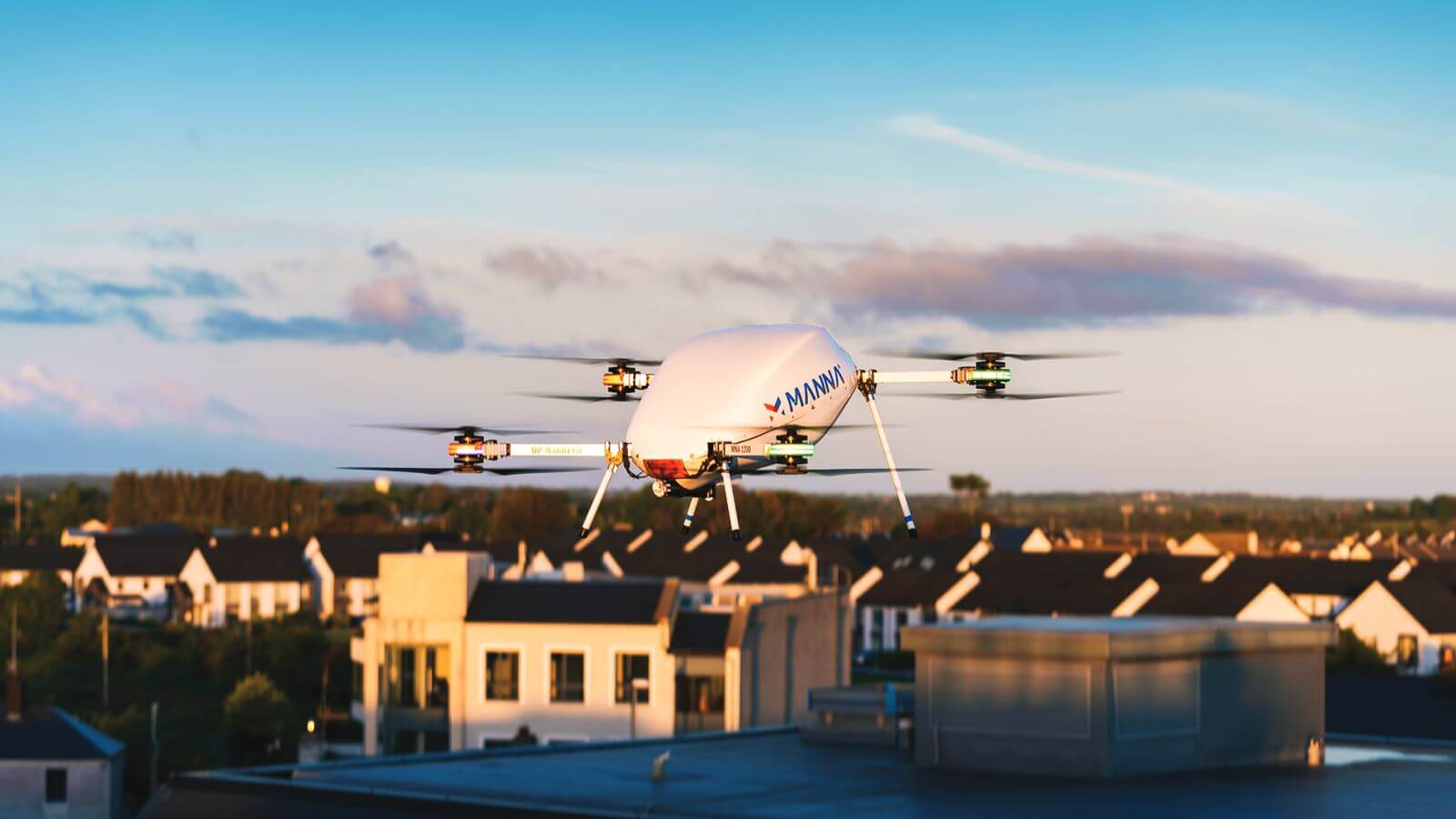
Manna has come a long way since 2021, with significant progress in technology, regulation and market penetration. This is even more impressive when we see it in the context of unit economics which Manna advises are “positive”. They are not, however, able to operate in the UK due to more restrictive regulations than other countries, for example Ireland and the USA. We also wonder if Manna’s positive view on perception would apply to the UK, as our 2023 Building Trust in Commercial Drones paper found that delivery drones were one of the least supported use cases.
One of the most striking numbers In Skies Without Limits V2.0 was the £10bn TAM (Total Addressable Market) for UK last-mile delivery drones. However, at the time of writing, practically none of this has been realised. There are still no volume deployments of last-mile delivery drones in the UK, despite many successful trials such as Future Flight Challenge project Caelus[1] and some promising Royal Mail projects such as Orkney I-Port (Skyports) and Windracers collaboration.[2] In Skies Without Limits V2.0, we also noted that Amazon Prime Air had wrapped up their operations in the UK (2021), casting potential doubt on the viability of the industry. However, there is now evidence of another attempt by Amazon to enter the UK market and we note their participation in upcoming BVLOS trials[3].
Manna have progressed significantly in the last three years but this progress is elsewhere, including Ireland and the USA. In Skies Without Limits V2.0, we stated:
“If we look at the global picture for Last Mile Delivery drones, we can conclude that other countries such as Ireland, USA…have made more tangible progress than the UK. This does not appear to be due to technology (UTM, Electronic Conspicuity, Detect and Avoid and Drone Autonomy, etc) which is not notably different. It may be due to a different attitude to risk in the UK…”
Manna
Although there is still a noticeable difference in risk attitudes between the UK and other regions (refer to the Cyberhawk case study update for a USA/UK risk perspective), there appear to be additional areas where the UK was once on par but has since lagged. Over the past three years, Europe and the USA have made considerable advancements in Technology and Regulation (refer to Section 4, above), a progress not matched domestically. In Technology for example, Manna highlights the criticality of UTM to their business, particularly at scale.
“UTM technologies are crucial for UK BVLOS drone operations. The integration of Unmanned Traffic Management (UTM) systems is essential for managing the increased air traffic volume associated with BVLOS operations. These technologies ensure that drones can operate safely and efficiently alongside both unmanned and manned aircraft, preventing collisions and facilitating smooth traffic flow. Additionally, UTM systems support regulatory compliance by providing the necessary infrastructure for monitoring and controlling drone flights, which is vital in the UK’s densely populated and complex airspace.”
Manna
As we note in Section 4 of the full report, UTM appears to be viewed as a foundational technology in the USA and Europe but UTM in the UK is not planned until 2026 at the earliest, refer to the Future of Flight action plan[4].
Manna’s perspectives on barriers to growth make for interesting viewing and paint a much more positive picture than we expected. They reflect Manna’s impressive progress in the last 3 years and their achievements include:
- Unit Economics Manna has achieved “positive unit economics”[5] and are operating at commercial volume in Ireland (Blanchardstown) from Q1 2024. Manna claims that the operation covers 42K households and 150K people
- Regulation Manna can fly in Europe and the USA: EASA (European Union Aviation and Safety Authority) BVLOS LUC (Light UAS Operator Certificate) attained; FAA (Federal Aviation Administration) Part 107 waivers obtained to operate in Dallas, Texas[6]
- Technology Manna claim significant progress in their proprietary drone’s autonomy, weather tolerance, carrying capacity and endurance; they have also progressed flight planning and one-to-many piloting

The 2024 colour indicator shown is based on Manna’s current perception of the associated barrier (red indicates an 'issue' and green 'no issue'). The trend shows the degree to which they feel this barrier has changed since 2021. To see a summary of how this organisation's views compare to others, see the chart on page 8 of our main report.
The positive view of the Perception barrier (green – up) is interesting but reflects countries other than the UK. In the UK, drone deliveries continue to be one of the least supported use cases according to our recent survey (BTiCD[7] 2023, 61%). However, this represents a substantial increase compared to our earlier market research (BTiD[8] 2019, 26%) but it is important to note that the respondent populations differed between these surveys.
“88%+ of consumers are in favour of the service…Over the past 3 years, we have seen increased levels of acceptance and a sense of inevitability across investors and the business community that drone delivery will be part of the fabric of modern society in the near future.”
Manna
Changes in Implementation (green – up) are based on Manna’s movement from serving 10K people in one location in 2021, to multiple locations around the world in 2024. This includes Blanchardstown where 150K people are in the delivery area, and the start of new operations in Dallas, Texas. It is a slightly different story on Regulation (amber – up). Manna’s achievements in this area are noted above but there is still more progress required in the EU and USA to scale up and in the UK to start operations.
“The EU regulatory framework, governed by EASA, including the U-Space legal requirement, is ready for drone delivery at scale. This framework provides a solid foundation that supports the safe and efficient operation of drone deliveries. We look forward to local airspace regulators across the EU demonstrating their ability to comply with these regulations at an appropriate pace, ensuring that permits allow safe operators to build out initial scale effectively. We also welcome recent communications from the FAA, which will soon publish the new Part 108 unmanned aviation requirements, and the UK CAA, which announced the adoption of a SORA-style approval framework by late 2024 or early 2025. These regulatory developments are crucial for facilitating the widespread adoption and scalability of our drone delivery solution.”
Manna
Manna’s view on Skills (up – amber) is, perhaps, what we would expect from a company pushing technology and regulatory boundaries. Finding skills in drone manufacturing, unmanned aviation engineering and AI has been particularly challenging, but they are taking steps to address this.
We will close with Manna’s thoughts on the changes they would like to see in the UK.
“We see several key areas for improvement in how the UK handles drone operations. Firstly, there is a need for streamlined regulatory processes that can adapt to rapid advancements in drone technology, including more efficient procedures for obtaining BVLOS permissions and integrating new technologies such as detect-and-avoid systems. Secondly, increased investment in Unmanned Traffic Management (UTM) infrastructure is crucial to ensure safe and efficient airspace management as drone traffic continues to grow. Additionally, there should be a greater emphasis on public education and awareness campaigns to improve the perception of drones and highlight their benefits to society. Enhancing training programs and certifications for drone operators will ensure high standards of safety and professionalism across the industry. Finally, closer collaboration between regulatory bodies, industry stakeholders, and technology providers is essential to facilitate the development of robust frameworks that support innovation and the safe integration of drones into UK airspace. These changes will enhance safety and efficiency, support the growth and integration of drone delivery services in the UK.”
Manna


Notes:
[1] AGS, Caelus
[2] SUAS News Skyports and Royal Mail to extend UK’s longest running commercial drone delivery service
Windracers, Royal Mail reveals ambitious vision for more than 50 new postal drone routes in partnership with Windracers Group
[3] CAA New trials set to help unlock drone deliveries and inspections in the UK
[4] DfT, Future of Flight Action Plan
[5] Per Manna, this reflects cost per delivery being lower than revenue per delivery, assuming utilisation is more than 55%
[6] Per Manna, the part 107 waivers set the stage for them to pursue a Section 44807 airworthiness waiver and a waiver to FAR 91.113 (allowing BVLOS flight). These allowances will enable them to fly BVLOS drone delivery under a UAS Part 135 certificate, which will be acceptable to scale until the FAA’s Part 108 recommendations become law
[7] PwC and DSIT, Building Trust in Commercial Drones
[8] PwC, Building Trust in Drones
An insight into the progress of the UK drone industry from 2021 to 2024
Skies Without Limits v3.0