



This is a progress update of a case study from 2022, which we recommend reading first for background and context.
Read the 2022 case study Read the full report

The remarkable thing about Plowman Craven’s solution in 2021 was the absolute accuracy they achieved while surveying railways which enabled them to deliver a host of safety, cost and efficiency benefits. Their perception of the status of the barriers to growth identified in Skies Without Limits V2.0 is equally remarkable, they are the only respondent to consider that all barriers were green (no issue) in 2021 and are still green in 2024. This reflects a company whose belief that it is in control of its own destiny has allowed them to develop and expand their drone solution over the past three years – they see drone solutions as complementary to their traditional land survey business rather than an end in themselves.
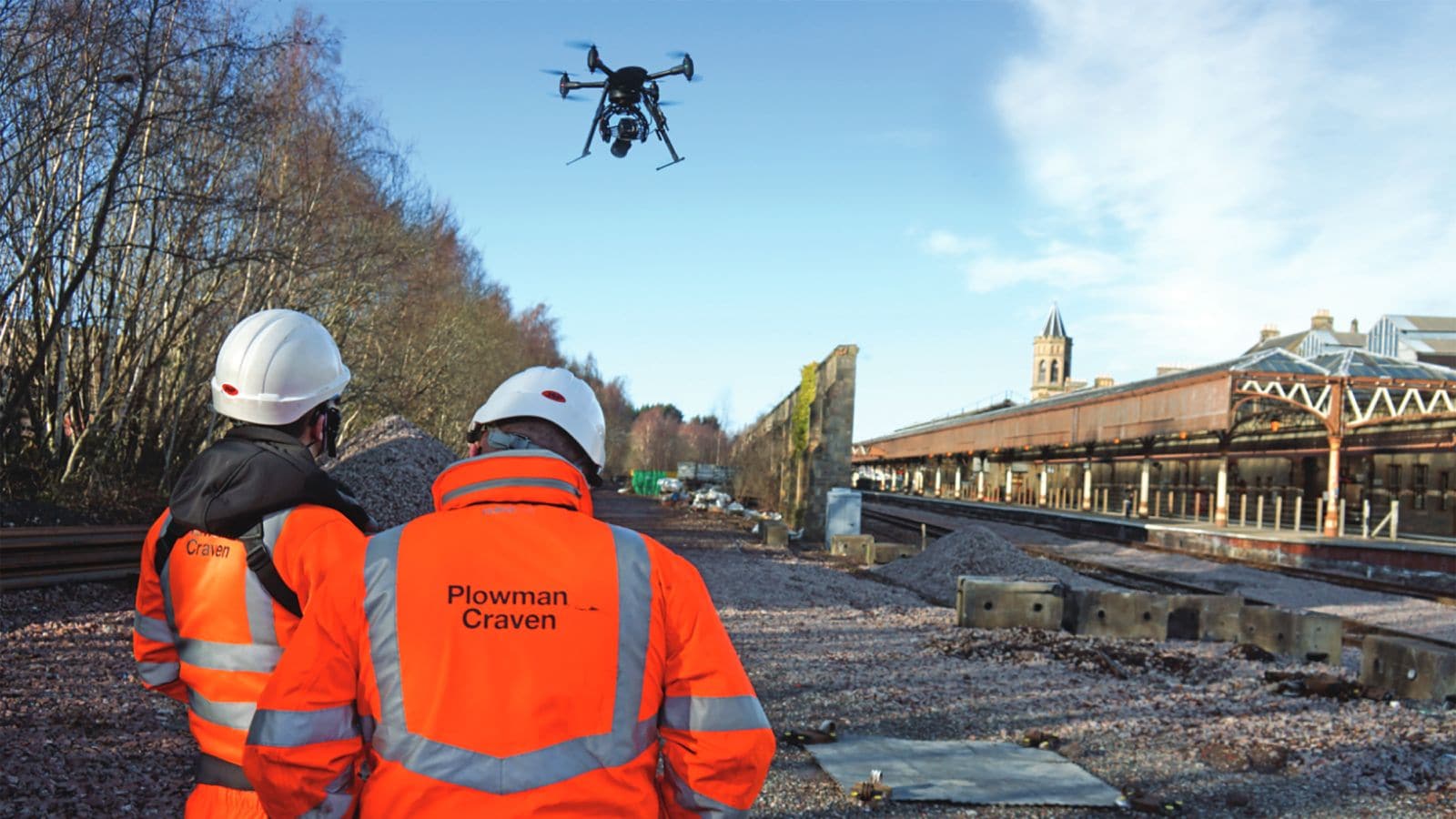
Since Skies Without Limits V2.0, Plowman Craven have improved and rebranded their highly accurate drone solution. What was previously Vogel R3D is now Vogel Freedom and flight height for the Network Rail band 1 accuracy (+/-5mm absolute accuracy) is now 10m higher at 35m vs 25m. They claim that, with their solution, there is no need to have “boots on ballast” (people on the track), nor to interrupt rail traffic (no “possession” of the track required) and, as a result, the following benefits are delivered:
“20% faster, dramatically cutting the typical labour and time intensive track-based tasks such as the installation of ground control points. This means that mobilisation times are now faster than ever, down from weeks to days, and the programme’s speed of delivery enhances the client journey, delivering valuable data quicker; 30% cheaper, reducing the need for extensive hours of work for safety critical staff, allowing work to take place during daylight hours (as opposed to midweek nights and weekend possessions) and reducing the overall time spent on site. This results in major savings across project lifecycles; 85% lower carbon, due to a vastly lower number of staff needed on site. In turn, less site time means fewer shifts required across projects and reduced travel (and associated emissions) to and from sites. This is aligned with the decarbonisation targets for the UK’s rail networks and wider net zero ambitions in the UK.”
Plowman Craven
They also note that business has grown at the rate they expected in 2021 and “UAV operations service a large portion of PCL [Plowman Craven] revenues.”
Plowman Craven’s atypical scoring of the Skies Without Limits V2.0 barriers to growth (all green, all flat) suggests a company that feels in control of its own destiny and does not perceive its growth to be constrained by these factors.

The 2024 colour indicator shown is based on Plowman Craven’s current perception of the associated barrier (red indicates an 'issue' and green 'no issue'). The trend shows the degree to which they feel this barrier has changed since 2021. To see a summary of how this organisation's views compare to others, see the chart on page 8 of our main report.
The Perception traffic light (flat – green) looks encouraging on the face of it but Plowman Craven say:
“Clients are open to our solution or sometimes indifferent.”
Plowman Craven
We found the “indifferent” point fascinating. As longtime advocates and heavy users of drone solutions we were surprised some of Plowman Craven’s clients felt this way. We can speculate that in the land survey market, where Plowman Craven operate, clients are looking for a survey of a given accuracy at a given price point and do not care whether this is delivered by drones or using traditional methods such as ground-based laser scanning or GPS pole. We could also say that, in the land survey field, drones are very much considered business as usual, as reflected in Plowman Craven’s views on the barriers to growth.
We have the same trend and rating for Implementation and Plowman Craven notes that “deliverables are easily accepted.” If we dig a little, however, drone reports are being delivered in the same manner as traditional land survey reports with files often shared using cloud storage and then manually uploaded to the end clients’ systems. This, though effective and acceptable to the client, is quite different to seamless delivery through a Visual Asset Management (VAM) system which is integrated with the client’s systems, refer to the Cyberhawk case study.
Technology (flat – green) reflects Plowman Craven’s pioneering development and evolution of the Vogel system noted above, along with their work on machine learning analytics. If we combine this with Regulation (flat – green), a picture emerges of a company who “currently fly multi-rotor drones over discrete sites”. They do, however, note that “CAA regulations which enable “Drone in a Box” solutions” would be desirable, but this is not enough of an issue to consider the barrier to be amber. Closing with Skills (flat – green), Plowman Craven trains their own pilots, completing the picture of a company very much colouring within the lines while still innovating, growing, and delivering faster, safer, more cost-effective, and environmentally friendly solutions for their clients.


An insight into the progress of the UK drone industry from 2021 to 2024
Skies Without Limits v3.0