



This is a progress update of a case study from 2022, which we recommend reading first for background and context.
Read the 2022 case study Read the full report

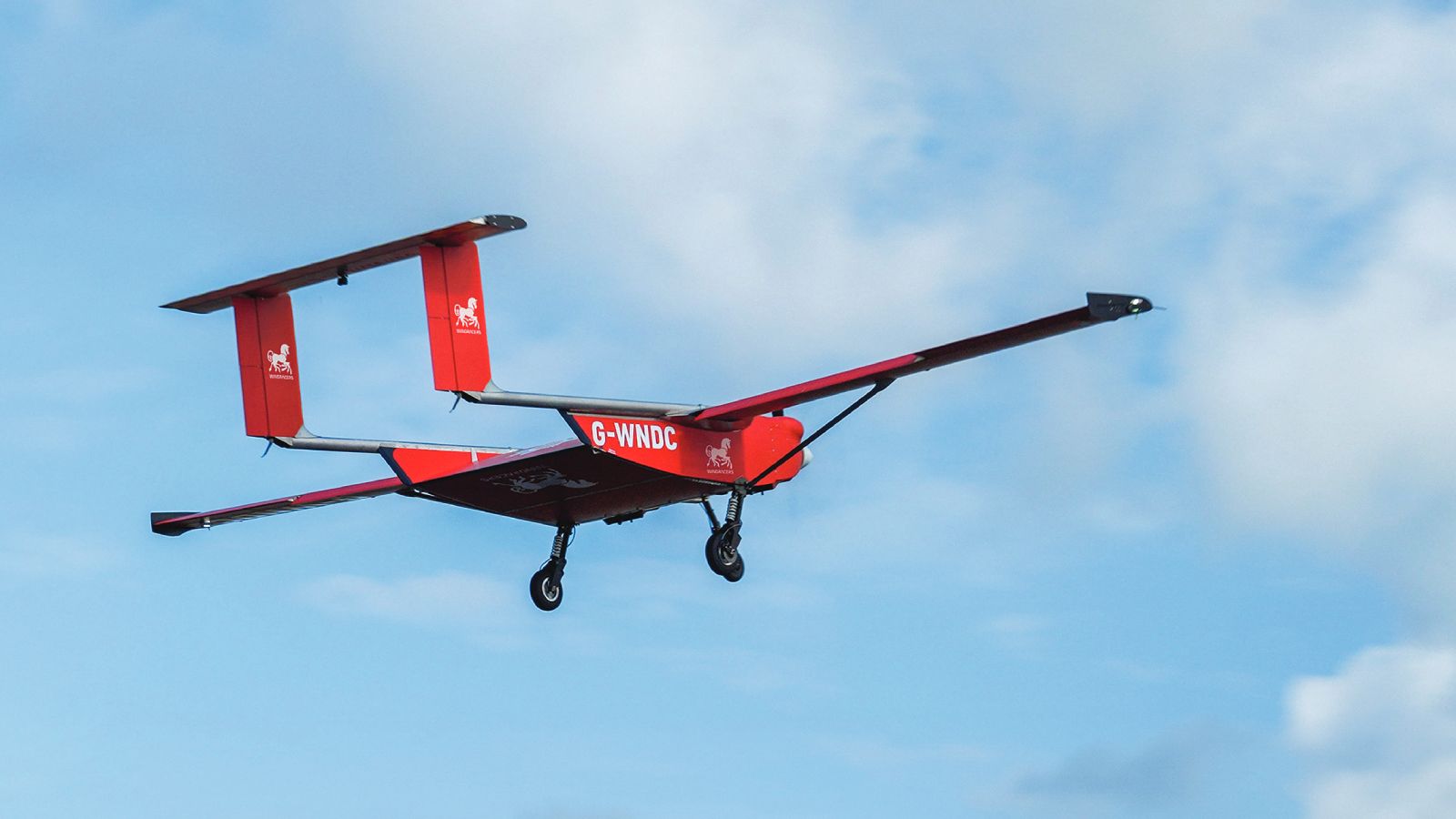
Windracers have made remarkable progress since 2021, leveraging their UK achievements to capitalise on international opportunities in both military and commercial sectors. They believe that the Ukraine war has shifted the UAV market from a question of “if” to “when”. This surge in international demand has enabled Windracers to transition from “lab to life” and has led them to establish an “automotivelike” production facility in the UK.
Progress within the UK has been more gradual. Windracers would like UK regulators to expedite the approval process for Beyond Visual Line of Sight (BVLOS) operations, especially those with strong end customer demand which fly over sparsely populated areas.
Since 2021, Windracers’ most significant achievement has been transitioning their business from “lab to life”. They have advanced from a concept aircraft that completed several BVLOS trials in the UK to a fully developed enterprise, manufacturing drones on a commercial scale and expanding production to meet growing demand from international customers and prospects.
One of the drivers for this is the Ukraine war.
“With the Ukraine war, there has been a general acceptance that drone technology will play a role in all areas of transportation. As Windracers ULTRA is deployed in Ukraine and has carried out missions for other organizations, what has also become apparent is the need for multimission capability of UAV platforms. Windracers ULTRA has been designed to carry out 3 core use cases – deliver, drop and detect – so that one ULTRA can carry out multiple missions depending on customer need.”
Windracers
Windracers’ optimism is evident in their assessment of growth barriers. Perception (up – green) has improved to the extent that it is no longer a concern. This is not surprising for a startup that has successfully navigated the challenging transition to commercial scale. It is particularly impressive given that their business relies on BVLOS operations, a model others have struggled with.

The 2024 colour indicator shown is based on Windracer’s current perception of the associated barrier (red indicates an 'issue' and green 'no issue'). The trend shows the degree to which they feel this barrier has changed since 2021. To see a summary of how this organisation's views compare to others, see the chart on page 8 of our main report.
“Unlike others in the same space, Windracers has moved well beyond prototype and is operating on 3 continents and in a wide range of environments.”
Windracers
Implementation has also improved (up – amber); however, the evolving nature of the technology means that clients are still adapting their existing systems to integrate these new solutions. As mentioned earlier, the company believes that “multi-mission” capabilities— delivery, drop, and detection—are the optimal use of their drones, which increases the complexity of integrating drone operations with regular business activities. This will not stop Windracers striving to be “the Jeep of the sky.”
Windracers believe that Technology has not progressed since 2021 (flat – amber) and still has some way to go before it ceases to be a barrier to growth. This underscores opportunities for advancements in areas such as autonomy (including Detect and avoid and swarming) and Unmanned Traffic Management (UTM). However, there is a nuanced perspective on whether UTM is necessary for BVLOS, perhaps reflecting a healthy scepticism influenced by the middlemile viewpoint. When asked whether UTM is required for BVLOS in the UK.
“UTMs would provide a potential way forward for this, providing they can integrate easily into existing methods for airspace coordination. Typical operations for Windracers aircraft in UK Airspace is in two categories or phases: Local to Aerodromes (e.g. VLOS flights for testing purposes, or departure / arrival from operations that transit regions for logistics purposes) and BVLOS transit routes between Aerodromes. These have two different altitude considerations, but primarily all BVLOS phases of flight occur at above 1000ft, meaning a straight UTM only tool, may not add that much benefit.”
Windracers
It is noteworthy that UK-based Windracers is collaborating with a US university (Purdue University) on “bringing more AI enablement into making the operation of their ULTRA drone more efficient and lower cost”. They are also collaborating with the University of Bristol on swarming technology[1].
As with most BVLOS-dependent use cases, Regulation has progressed (up – amber). The company appears to be more understanding and positive than many regarding the actions of the regulator, although they acknowledge that further progress is needed.
“Regulation has always been a challenge as the regulators, quite appropriately, are moving cautiously. As we are operating in the UK and other markets, Windracers has seen significant progress in the UK and noted that some countries are moving faster to establish regulatory frameworks than others to enable consistent BVLOS operation of larger UAVs. In Windracers’ view, the countries that are moving faster to establish regulations that enable BVLOS operation of larger UAVs see a commercial competitive advantage in moving forward with a more permissive regulatory regime. While limited Beyond Visual Line of Sight (BVLOS) permissions have been obtained, unlocking the use case, additional regulatory progress is still required.”
Windracers
We will close with the changes Windracers would like to see in the UK. They suggest that regulatory regimes for BVLOS operations of larger UAVs in all markets should focus on low-populated areas which have clear end-client demand. Establishing rules for such areas would enable consistent BVLOS operations with lower risk (compared to operations over densely populated areas) and provide delivery services to populations that lack the same access and cost benefits as those in more densely populated areas.
“Windracers believe that the driver for change should come from those places where there is true commercial need. As an example, from our experience in operating in the Orkney Islands, we understand that currently it takes days for Amazon packages to arrive to people in that area whereas for people in London, it takes hours, sometimes even the same day. There is a true commercial need in the Orkney Islands – and many other areas across the world – for faster delivery of non-urgent parcel, post and cargo…If changes can foster more regular BVLOS operation of larger UAVs, a new market for delivery routine services could be created and the commercial use cases could be better understood and served.”
Windracers

An insight into the progress of the UK drone industry from 2021 to 2024
Skies Without Limits v3.0