



A progress update of this case study is now available, but we recommend reading this original version (from 2022) first for important background and context.
Read the progress update Read the full report
The agriculture industry has a long history in the UK and has experienced multiple technology revolutions. Drones and autonomous vehicles are the latest catalyst for transformation in agriculture and can be used to gather crop health data, spray crops and even seed fields. They are faster, reduce waste, make better use of land, are better for the environment and, ultimately, improve overall crop yield.
In the UK, drones are being used to survey farmland and assess the health of crops. One way to do this is using multispectral analysis such as NDVI (Normalised Difference Vegetation Index), which can differentiate between sick and healthy plants based on how much light they reflect. Other approaches include thermal imagery and analysis of photos. Drones can safely and rapidly give farmers an understanding of the health of their crops, enabling them to target treatments and improve overall decision making.
Drone AG is a company aiming to simplify this process for UK farmers. They use photos and AI analysis to assess crop health and have an app called “Skippy” that enables farmers to fly drones and capture data about their crops through a simple smartphone-based interface. The app produces a report which identifies how “healthy” a farmer’s crops are, whether there are unwanted invasive species growing amongst them and whether this is causing any crop damage.
“We created Skippy Scout with the goal of making the jobs of farmers easier. This translated into saving time and money for the farmer initially, but has other important benefits as well. The Skippy app is highly accessible and controls a standard, off-the-shelf drone, with no special sensor attached, autonomously flying it in order to inspect crops at leaf-level. It automatically works out the fastest route around a field and takes sample photos throughout. These photos are automatically stored, uploaded and analysed using custom AI. PDF field health reports are automatically produced and emailed to the user within minutes of a completed flight, providing the farmer with important and actionable metrics on the crop’s uniformity and health.
The current flight algorithm makes this process around 10 times faster than walking. The next algorithm will be 20 times faster. Our own calculations estimate that Skippy Scout saved approximately 100 UK users over 785 hours of labour last season by reducing hours spent inspecting crops on foot. It is also now operating globally across over 18 countries and in over 500 farms. Skippy not only highlights the health of the crop on average, across the whole field, but gives location specific metrics as well. This allows for “variable rate” application of chemicals and fertiliser, as opposed to set rates for the whole field, meaning that the farmer can save money on expensive fertiliser and pesticide. This also means reduced chemical and fertiliser usage, causing less runoff into the surrounding environment.”
Drone Ag
Detailed crop data like this enables farmers to precisely identify and directly address problems. One action may be to carry out targeted crop spraying using drones. Pioneered in Japan in the early 1990s, there are now several global examples of drones being used for crop spraying. In some instances, using a drone to assist with crop spraying has reduced the amount of chemical sprayed on crops by over 30%.
Despite the benefits, in the UK, the use of spraying drones is currently not permitted under the Chemicals Regulation Directorate (CRD). However, there is mounting pressure for these regulations to be changed, with the May 2021 TIGRR (Taskforce on Innovation, Growth and Regulatory Reform) report encouraging the Health and Safety Executive to “reconsider these requirements at pace” to allow increased innovation within the agricultural sector.
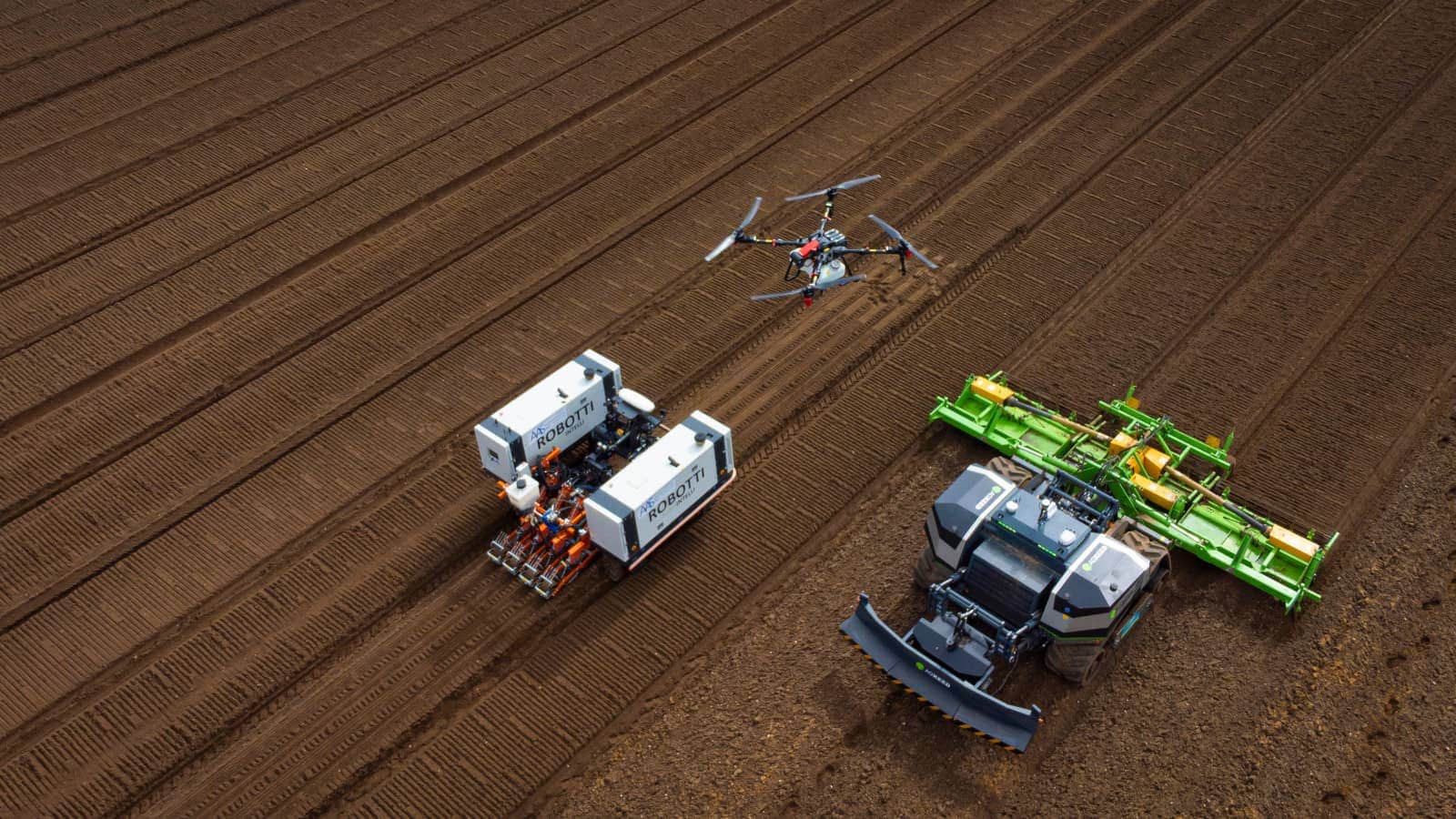
One company looking to capitalise on any potential change is Auto Spray Systems, who has a robot and drone system that work in tandem in an effort to bring efficient crop spraying to the agriculture sector. These vehicles are intended to improve process efficiencies throughout a crop’s lifecycle, all whilst lowering associated carbon emissions. After initially mapping crop health in a field, their drone and robot can then get to work on delivering fertilisers to where they are needed most. The intention is that this approach reduces the amount of chemicals used and, accordingly, the impact on the environment. The small size of the robot and aerial nature of the drone also protect the soil from unnecessary compaction.
“The optimisation of the rate of application of nitrogen to growing crops is key for both the profitability of agriculture and the wellbeing of the environment. It is necessary to gather information at a very high spatial resolution with regard to the status of both the available soil nutrient content and the development of growing crops in order to make optimal calculations of crop nutrient requirement.
Drones and lightweight autonomous vehicles offer the ideal platforms for a range of innovative sensors which can measure both soil and crop status with ever greater accuracy.
Crop health data is taken from two sources: first a drone scans the field for a high level view of the crop’s health. Then a ground based robot with a multi-spectral camera scans the crops for a per-plant level view. This data is combined to provide a high resolution map of the field’s nitrogen levels.
This high resolution map is then used to control the nitrogen application rates, ensuring the crops get exactly the amount of nitrogen they need and not too much. In order to apply the nitrogen with the accuracy needed, a ground based robot or drone can be used.
The drone is much preferred as it avoids crop damage and eliminates soil compaction. This allows the farmer to apply “little and often” which is the proven way to maximise Nitrogen Use Efficiency (NUE).”
Auto Spray Systems
The ultimate vision for drone use in agriculture is for systems, such as the ones seen in this case study, to “scan, seed and feed”. That is, utilise drones at every stage of a crop lifecycle to bring automation and efficiencies. The future of drones in this sector is very dependent on legal changes, which if allowed, have the potential to unlock a more efficient, greener approach to agriculture in the UK.

This case study is an extract from the report
Skies Without Limits v2.0