




This necessity comes at a time when many organisations are experiencing a GenAI ‘reality check’. Last year, 45% of CEOs told us they expected GenAI to increase both revenue and profitability within 12 months. But this year, our 28th UK CEO Survey revealed almost 80% have seen little to no change to profitability (79%) or revenue (78%). CEOs have now recalibrated their expectations, with just 36% saying they expect GenAI to increase profitability this year.
However, in stark contrast, we’re seeing the largest venture capitalists, particularly those on the West Coast, actively exploring disruptive platform plays. They are systematically - and strategically - examining industries to determine where funds can be allocated for maximum impact through AI technologies.
This flow of funding should be a wake-up call for traditional businesses, because it necessitates a reassessment of business models. Embracing AI not only involves technology updates but also rethinking organisational structures and strategic priorities. This requires a forward-looking mindset that anticipates the long-term benefits of AI, rather than focusing solely on immediate disruptions or costs.
Too often, AI is seen as a disruptor - a force that challenges existing structures. However, forward-thinking organisations are beginning to recognise AI as a strategic ally, one that can uncover business opportunities and transform market challenges into competitive advantages. By adopting a comprehensive approach to AI integration, companies can transcend traditional limitations and redefine market leadership in increasingly AI-driven sectors.
The real cost of AI: understanding investment
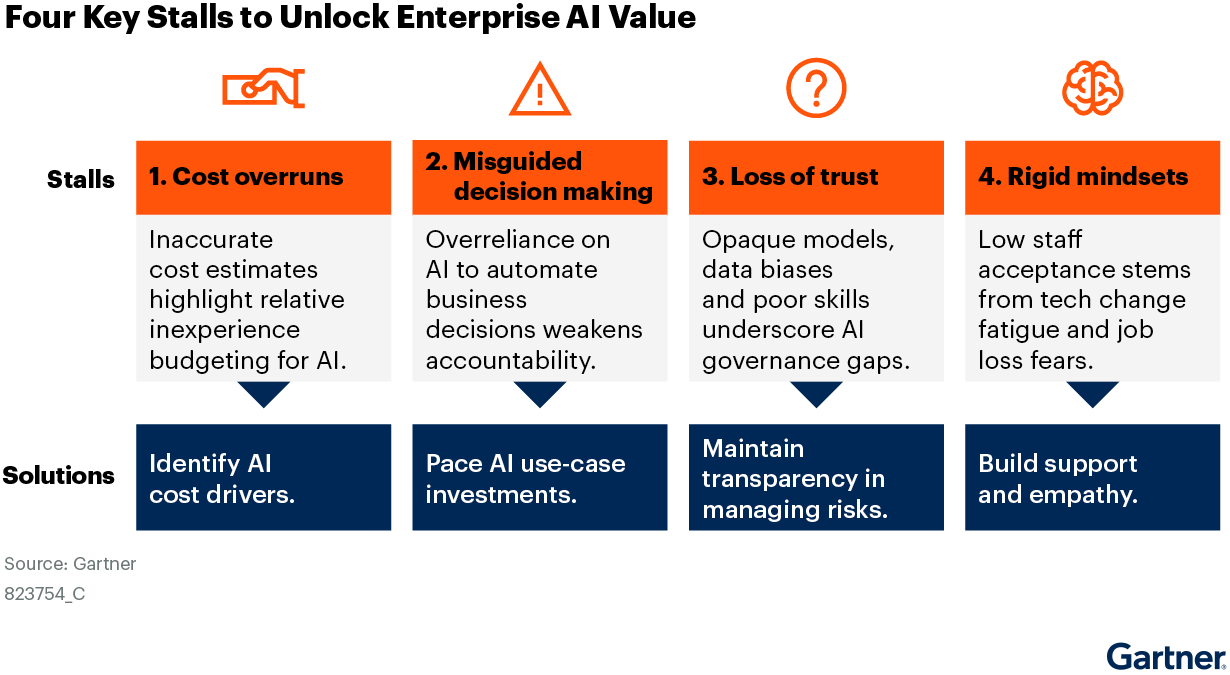
While AI’s promise is boundless, the path from concept to production can often reveal hidden costs and challenges. According to the recent Gartner® article, CFOs Must Overcome 4 Key Stalls to Unlock Enterprise Value AI: “cost overruns, decisions-making risks, loss of trust and rigid stakeholder mindsets all threaten the promised return from accelerating investments in AI.” While aimed predominantly at CFOs, there is a message here - and lessons within the report - for all.
A regular pitfall is the underestimation of expenses associated with ‘productionising’ AI - putting it into action.
Bringing AI from concept to production can raise unforeseen challenges and costs. While developing a small-scale, proof-of-concept AI is manageable, expanding these systems for full business use can become complicated and costly. Traditional financial forecasts frequently overlook the multifaceted expenses associated with full AI integration and maintenance.
A significant yet overlooked cost factor is the transactional nature of AI Agentic frameworks. Many AI Agent vendors and platforms will charge organisations on a ‘transactional plus consumption’ basis. As businesses dive into multi-modal AI deployments, encompassing vision, language and sensor data, these transactional costs can escalate quickly. This is especially true in sectors employing advanced AI features such as real-time image analysis, reasoning or speech.
The initial design of AI can also greatly affect costs. Rushed or poorly planned AI solutions often lead to unexpected expenses. Using models mismatched to use cases, inefficient approaches to training models, inferencing methods, data handling or processing, and excessive consumption costs from poor design can all cause monthly costs to skyrocket. With many organisations still experimenting and building initial versions of AI systems, inadequate model design or improper technology application could result in significant monthly bills if not managed correctly.
The open versus closed model debate also adds layers to cost considerations. Though open-source models offer customisation and cost-effective initiation, they entail ongoing maintenance expenses - costs companies might avoid with proprietary models requiring significant upfront investments. As AI technology develops, companies need to carefully consider these options, possibly using smaller, cost-effective models for specific tasks. It is likely we will see the increased use of Small Language models (SLMs) for certain use cases as costs rise, prompting reconsideration of current frameworks. Gartner® puts it simply: “enterprises experience economies of scale with experimentation and rollout costs, but ongoing costs continue to compound over time.”
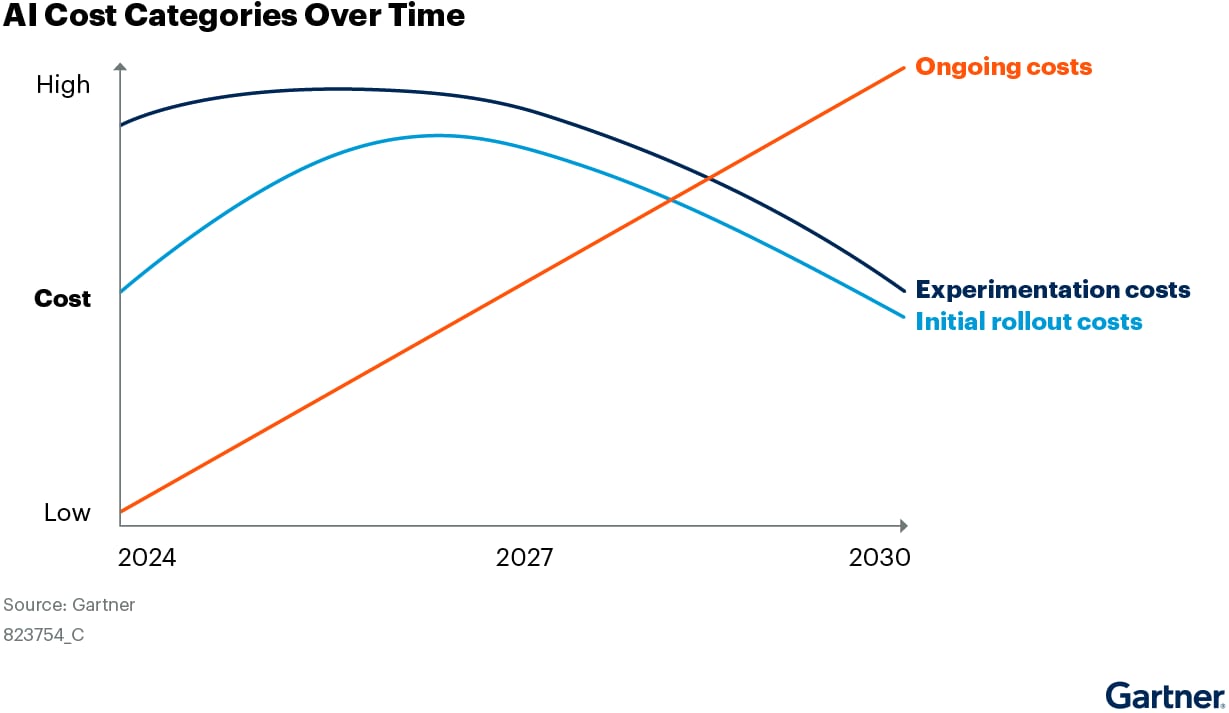
Source: Gartner, CFOs Must Overcome 4 Key Stalls to Unlock Enterprise Value AI, Clement Christensen, 24 January 2025
Gartner key findings
- Spend estimates for AI are often wildly inaccurate due to unforeseen and unpredictable costs that significantly disrupt financial planning, budgeting and forecasting.
- The proliferation of AI is transforming how enterprises operate and make decisions, yet organisations face risks of doing too much too soon. CFOs are ideally positioned to lead the enterprise response to pacing AI investments and overcoming potential stall points by leaning into their traditional strengths of financial expertise and risk management.
- Breaches in trust caused by error, limited governance or a lack of AI understanding can harm relationships with customers, investors, regulators and shareholders and result in potentially significant financial losses.
- Change fatigue and fear of job elimination can lead to staff resistance against expanded AI use, further delaying the expected returns from AI investment.
Source: Gartner, CFOs Must Overcome 4 Key Stalls to Unlock Enterprise Value AI, Clement Christensen, 24 January 2025
Reframing AI's ROI
Determining AI's return on investment goes beyond traditional financial metrics. While direct benefits like cost savings and revenue increases are tangible, the nuanced metrics capturing AI’s multifaceted impact - such as enhanced operational efficiencies and improved customer experiences - are equally vital. Companies must define success metrics that align with broader business objectives, ensuring AI investments translate into holistic strategic value.
The real challenge lies in aligning AI initiatives with the company's strategic roadmap. This means integrating analytics into every facet of the organisation, from customer service and supply chain management to marketing and product development. By tracking key performance indicators and continuously refining AI algorithms, businesses can ensure their investments yield measurable results.
Investments in AI should focus on building a strong infrastructure that allows for growth and flexibility. Setting up platforms that can integrate across various business areas will ensure lasting value. This strategic foresight not only maximises ROI but also enhances the company’s proficiency with AI, which is crucial for competitive advantage. As companies move from small tests to complete AI solutions, leaders must ensure their teams have the necessary resources and skills to fully benefit from AI.
- By 2028, more than 50% of enterprises that have built their own generative AI models from scratch will abandon their efforts due to cost, complexity and technical debt in their deployments.
- By 2027, 60% of enterprises will fail to realise the anticipated value of their AI use case due to incohesive ethical governance frameworks.
Source: Gartner, CFOs Must Overcome 4 Key Stalls to Unlock Enterprise Value AI, Clement Christensen, 24 January 2025
A change of culture: the imperative for innovation
Any transformation needs to go beyond mere adaptation - it must look towards reinvention as a path to growth. It requires an overhaul of entire business models: to think proactively, to anticipate potential upheavals and to be adaptable enough to capitalise on innovation.
A significant shift is required within organisations to turn AI’s potential into practical outcomes. Cultural innovation will necessitate bold decision-making that challenges existing models and embraces experimentation over hesitation. Effective leadership must integrate AI seamlessly, leveraging it to redefine customer journeys and optimise business processes. Organisations at the forefront of AI implementation, exemplify this approach, equipping staff with the skills needed to transform traditional methods and deliver strategic value.
Source: Gartner, CFOs Must Overcome 4 Key Stalls to Unlock Enterprise Value AI, Clement Christensen, 24 January 2025
At PwC, for example, we’ve accelerated our own GenAI journey to equip more than 15,000 of our UK staff with AI skills and tools, fundamentally transforming how we operate in some areas of the business. We’ve also worked with clients to do similar, helping SSE transform its internal audit process and allow its people to focus on more strategic, higher-level cognitive work.
The role of leadership in this transformation is critical. Leaders must foster a culture that encourages innovation and embraces change. This involves training employees in AI methodologies, promoting cross-functional collaboration, and setting up governance structures that facilitate agile decision-making.
Boards must critically evaluate existing models, adopting a ‘red team’ approach - stress-testing operational assumptions and proactively identifying vulnerabilities to pre-empt external disruptions. With the question no longer whether disruption will occur but when and how severely it will impact current operations, boards must think about how aggressively they need to be red teaming those models. What is the level of disruption they can endure before they are disrupted by external forces? The challenge they face is how limited they are by their own legacy structures.
There is an urgent need for businesses to advance to versions two, three (and beyond) of their models in an effort to make themselves more resilient, or make their market a less attractive disruption option. As industries start to explore what AI can do, leaders are increasingly discussing how to use it to transform traditional methods. Seeing AI as a main driver of change, rather than just an add-on, shifts the focus from merely coping with changes to actively taking advantage of them.
Other solutions could involve weaving AI into operational infrastructure to pre-empt market shifts and deliver a competitive base for organisations. Any change requires boards to embrace experimentation, to push past legacy structures and test the strategic opportunities AI offers.
Recommendations
- Avoid AI cost overruns by carefully categorising costs related to experimentation, initial rollout and ongoing support. Educate executives on each cost category as well as how to apply differentiated cost management tactics for controlling expenses.
- Advocate for proper AI use in decision making by promoting a paced approach for AI use-case investments and greater clarity around AI’s role in supporting, augmenting and automating decisions. Foster an enterprise-level understanding of AI’s complexities and regularly review AI performance.
- Develop and deepen external trust by administering an enterprise AI governance framework that establishes transparency in using AI through routine audited for data compliance, policies/tests for model accuracy and programs on workforce AI literacy to prevent errors and ensure ethical operations.
- Overcome rigid employee mindsets and resistance to AI by aligning rollouts with staff workload during periods where staff has the capacity to understand and execute changes in their workflows without exerting a high amount of additional effort. Support leaders in better emphasising with their team’s change fatigue and fears by deepening their understanding of AI as well as how to model new ways of work.
Source: Gartner, CFOs Must Overcome 4 Key Stalls to Unlock Enterprise Value AI, Clement Christensen, 24 January 2025
Success or survival: an inflexion point
We're now at an inflexion point where organisations must look to reinvent themselves in the pursuit of growth. That requires them to move out of proof of concept into production-ready solutions that transform customer journeys, optimise supply chain processes, redefine delivery models, and more. Many are still at the foothills, but we’re helping clients now move from the experimentation phase, to full-scale deployments that deliver tangible outcomes.
Efforts must be driven by leadership and be equivalent to the level of risk they’re willing to take. Boardroom structures must evolve to accommodate diverse perspectives that initiate decisive tech investments. Key decisions revolve around designing AI frameworks robust enough to challenge the status quo and align organisational aims with evolving technological paradigms.

Gartner, CFOs Must Overcome 4 Key Stalls to Unlock Enterprise Value AI, Clement Christensen, 24 January 2025.
GARTNER is a registered trademark and service mark of Gartner, Inc. and/or its affiliates in the U.S. and internationally and is used herein with permission. All rights reserved.
Contact us