



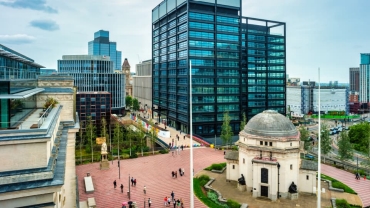
Birmingham has one of the youngest and most diverse populations in the UK, plays a central role in national infrastructure plans, and is gaining prominence in several key sectors. However, parts of the city face chronic deprivation and exclusion, with record levels of economic inactivity and long-term unemployment. Extensive regeneration, sector clustering, and skills development offer a chance to connect these left-behind communities to the city’s growth, ensuring the benefits of transformation are more evenly distributed.
Building on existing strengths
Birmingham has many of the foundations for long-term growth: a young and expanding population, a diverse range of sectoral strengths, an established university and research base, and strong national transport links. These foundations are being strengthened through the development of economic zones that connect key institutions, concentrate resources, and create the right conditions for growth.
The Knowledge Quarter, part of the West Midlands Investment Zone, is one of three economic zones across the city. The Knowledge Quarter supports growth in health, technology and life sciences by creating dedicated space for new research, innovation and training. Backed by the City Council, two universities and private partners, it is expected to create 20,000 jobs and form part of a Birmingham-London Innovation Corridor, using the new HS2 station to link research and investment opportunities between regions. Other zones target growth in technology, clean energy, advanced manufacturing, finance and business services and the creative and cultural industries.
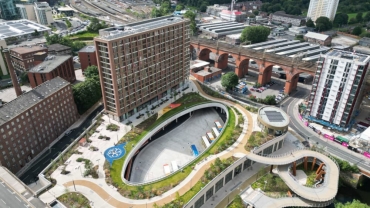
Large-scale regeneration projects aim to extend and connect these areas of growth. The Smithfield project, one of the largest city centre regeneration schemes in the UK, will transform a major brownfield site near Digbeth’s Creative Quarter, the Knowledge Quarter and the future HS2 station. Plans include 3,000 new homes, retail and leisure space, and new public areas.
Since 2020 the Council has been working to address this through a new and distinct approach to inclusive growth delivery focussed on East Birmingham. This has included strategic working with West Midlands Combined Authority (WMCA) and Solihull to secure government support for major development and infrastructure. It also includes partnership building with impactful organisations to address shared priorities and unlock funding and finance, along with a wide range of pilot interventions designed to build local economic resilience and social capital, reduce grant dependency, and support local SMEs, co-operatives and CICs.
Persistent barriers to opportunity
While these efforts help extend the growth of the city centre into the inner city, significant inequalities remain in large parts of the city. Over half (55%) of Birmingham’s most deprived wards sit in East Birmingham – the highest concentration of deprivation outside of London. Worklessness is a major factor, with 35% of residents economically inactive compared to 23% nationally. The twenty wards of East Birmingham's constituencies account for 2% of England’s unemployment.
“East Birmingham has been identified and targeted for major interventions around skills, wellbeing and health – the core factors that drive deprivation. Our focus is to break cycles of worklessness that have persisted for generations and connect communities to opportunities across the city.”
Richard Lawrence, Executive Director, Place, Prosperity and Sustainability, Birmingham City Council
These areas have poorer transport links, lower quality housing and limited access to green spaces, conditions that are closely linked to poor health outcomes. In the poorest parts of East Birmingham, life expectancy is up to 10 years shorter than in the city’s most affluent areas.
Linking people to opportunity
Birmingham's challenge is to connect more of its residents to the opportunities created through regeneration and sector growth.
From Smithfield, the Knowledge and Creative Quarters to the Sports Quarter and Arden Cross, regeneration zones now form a chain that stretches from the city centre into East Birmingham and North Solihull. They have the potential to act as bridges between areas of growth and areas of disadvantage, with the metro extension and HS2 promising to improve access new jobs, training and services throughout these areas.
Targeted support for skills and employment is also essential. While jobs are growing in the city’s core sectors, many residents lack the qualifications, training or pathways to access them. The Council, working with partners including the Integrated Care Board, is developing plans to support economically inactive citizens and create pathways into key sectors, occupations or self-employment. These efforts will help more residents benefit from the city’s strengths and ongoing transformation.


Contact us

Leader of Industry for Government and Health Industries, PwC United Kingdom
Tel: +44 (0)7841 783022



Follow us


